

Why Pipe Conveyors Are Ideal for Cement Plants, Mines, and Ports?
Conventional belt conveyors have been the standard for bulk material handling for decades. They work well for many applications. But there are situations where an open belt conveyor simply cannot do the job. The material is too dusty. The route is too curved. The site is near a residential zone. The material is hazardous or moisture-sensitive. In these situations, pipe conveyors are the right answer.
Pipe conveyors enclose the belt into a fully sealed tube using a set of specialised idlers. The material sits completely inside the pipe. Nothing escapes. No dust. No spillage. No material contamination. And because the belt curves around inside the tube, pipe conveyors can follow horizontal and vertical curves that a conventional belt conveyor cannot navigate without multiple transfer points.
Methods India has designed and delivered pipe conveyors for demanding industrial applications, including a 2.1 km pipe conveyor for PETRONAS in Malaysia handling sulphur at 450 TPH. With over 40 years of experience in bulk material handling, Methods India understands exactly where pipe conveyors outperform conventional systems and how to engineer them correctly for cement plants, mines, and ports.
In this blog, you will learn what pipe conveyors are, why they are ideal for cement plants, mines, and ports, what problems they solve, and why Methods India is the right pipe conveyor partner for your facility.
What Are Pipe Conveyors?
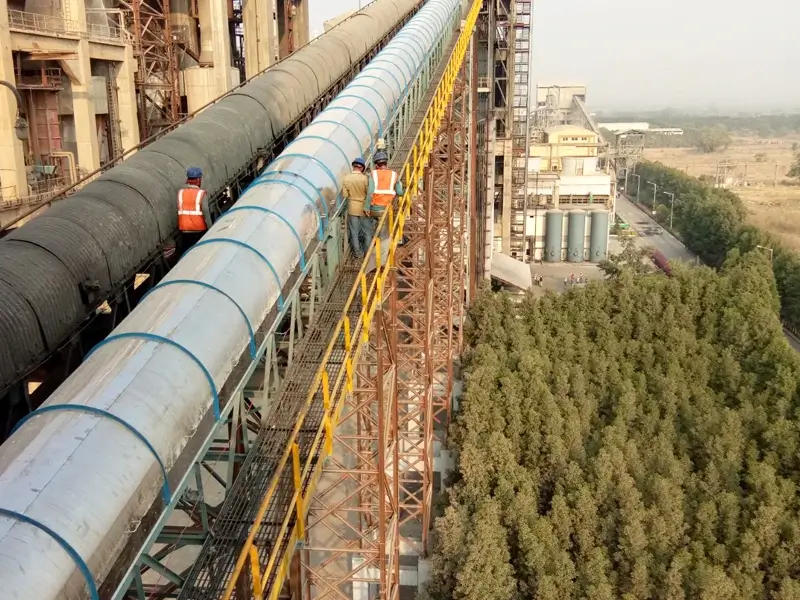
Pipe conveyors are an advanced form of belt conveyor where the belt is rolled into a circular tube shape using a series of hexagonal idler sets. Instead of transporting material on an open trough, the belt wraps around the material and encloses it completely inside a pipe-like cross section.
At the loading zone, the belt opens flat so material can be loaded onto it. As the belt moves forward, the idler sets progressively curl it into a tube. The material is carried inside this enclosed tube all the way to the discharge point, where the belt opens flat again to release the material.
So, the material never comes into contact with the external environment during transport. Dust cannot escape. Material cannot spill. Wind and rain cannot affect the cargo. This makes pipe conveyors fundamentally different from conventional belt conveyors and gives them a distinct advantage in environments where dust, spillage, and environmental compliance are critical concerns.
Pipe conveyors can also negotiate tighter horizontal and vertical curves than conventional belt conveyors. This means they can follow the natural contours of a site — going around obstacles, changing elevation, and navigating complex routes — without requiring intermediate transfer points that add cost and create dust and spillage problems.
What Problems Do Cement Plants, Mines, and Ports Face Without Pipe Conveyors?
Without the right pipe conveyor system, cement plants, mines, and ports face serious operational, environmental, and compliance challenges. Here are the key problems:
1. Dust Emissions and Environmental Non-Compliance
Open belt conveyors generate dust at every transfer point and along the conveyor length wherever the material is exposed. In a cement plant, this means raw meal, clinker, and limestone dust in the air. In a mine, coal or mineral dust. In a port, commodity dust from bulk cargo like sulphur, fertilisers, or coal.
Dust emissions create health hazards for workers. They create respiratory risks for nearby communities. And in 2026, they create serious regulatory non-compliance exposure with CPCB and State Pollution Control Board norms. Fines, operational restrictions, and plant shutdowns are real consequences of unchecked dust emissions.
Pipe conveyors eliminate dust at the source. The material is sealed inside the belt tube from loading to discharge. So, there is no opportunity for dust to escape along the conveyor route. Cement plants, mines, and ports that use pipe conveyors for dusty materials solve their dust problem at the system design stage — not through expensive downstream dust collection equipment.
2. Material Spillage
Open belt conveyors spill material. It happens at loading zones when the belt is overloaded. It happens on curves when centrifugal forces push material off the belt edge. It happens on windy days when lightweight materials like cement powder or fine coal blow off the belt surface. And it happens at transfer points every time material falls from one conveyor to another.
Spilled material is wasted product. It creates housekeeping costs. It creates slip hazards on walkways and access roads around the conveyor. It accumulates under return rollers and causes roller failures. In a port handling valuable bulk commodities, spillage is direct revenue loss.
Pipe conveyors eliminate spillage. The belt is sealed around the material from loading to discharge. So, every kilogram of material loaded at the tail end arrives at the discharge point. No spillage. No housekeeping costs. No roller failures from accumulated material. And no revenue loss from wasted commodity.
3. Complex Site Layouts and Routing Challenges
Conventional belt conveyors can only negotiate very gentle curves. If a conveyor route needs to go around a building, follow a hillside, or navigate a complex port layout, a conventional belt conveyor needs multiple transfer points to change direction. Each transfer point means a head pulley, a tail pulley, a discharge chute, a loading chute, a drive system, and additional civil structures to support them. Transfer points are expensive. They create dust. They cause spillage. And they are the points in the system most likely to block and break down.
Pipe conveyors can negotiate both horizontal and vertical curves in a single continuous system. The belt tube bends with the route. So, pipe conveyors can follow complex paths through cement plant layouts, across uneven mining terrain, and through the congested infrastructure of a port — all without intermediate transfer points. This reduces capital cost, reduces maintenance, and improves system reliability.
4. Hazardous and Moisture-Sensitive Materials
Some materials cannot be transported on open belt conveyors without creating serious problems. Sulphur ignites if it comes into contact with certain contaminants. Fertilisers absorb moisture and clump. Cement powder absorbs moisture from rain or humid air and becomes unworkable. Fine coal dust suspended in air is a fire and explosion risk.
Open belt conveyors expose these materials to the environment during transport. Pipe conveyors protect them. The material is sealed inside the belt and shielded from wind, rain, moisture, and contaminants throughout the conveying route. So, pipe conveyors are the correct choice for hazardous, reactive, or moisture-sensitive bulk materials in any industry.
Why Are Pipe Conveyors Ideal for Cement Plants?
Cement plants handle some of the dustiest and most abrasive materials in any industry. Limestone, raw meal, clinker, gypsum, and cement powder all generate dust when handled on open belt conveyors. Pipe conveyors solve the specific challenges cement plants face in their raw material and finished product handling systems. Here is why:
1. Enclosed Transport of Raw Materials and Clinker
Limestone is the primary raw material in cement production. It is crushed and conveyed from the quarry or stockpile to the raw mill. Along the way, fine limestone dust escapes from open belt conveyors at every transfer point and along the conveyor length. Clinker from the kiln is even more abrasive and dusty.
Pipe conveyors enclose both limestone and clinker completely during transport. So, dust emissions from these critical conveying routes are eliminated. This directly improves air quality in and around the cement plant and reduces the load on dust collection systems. Methods India engineers pipe conveyors for cement plant raw material handling with abrasion-resistant belt specifications that handle the aggressive nature of limestone and clinker without premature belt wear.
2. Cement Powder Handling Without Moisture Contamination
Cement powder is highly sensitive to moisture. Even a small amount of water can cause cement to pre-hydrate and clump, making it unusable. Open belt conveyors in humid climates or outdoor environments expose cement powder to rainfall and high ambient humidity. Pipe conveyors seal the cement inside the belt tube and protect it from moisture throughout the conveying route.
So, pipe conveyors are the right choice for conveying cement powder in outdoor environments or across distances where conventional enclosed conveyors would be impractical. Methods India designs pipe conveyors for cement powder handling with tight belt sealing at the loading zone to prevent any ingress of moisture during transport.
3. Navigating Complex Cement Plant Layouts
Cement plants have complex layouts built up over many years. Buildings, process equipment, and infrastructure often block the most direct conveying route between two points. Adding a conventional belt conveyor between two points in a congested cement plant layout often means cutting through structures, adding transfer towers, or taking very long indirect routes.
Pipe conveyors can follow the available space. They turn corners. They change elevation. They pass over roads and under structures using a single continuous belt. So, pipe conveyors make it possible to connect two points in a complex cement plant layout with a single conveyor system, eliminating the intermediate transfer towers and civil work that a conventional belt conveyor would require.
Why Are Pipe Conveyors Ideal for Mines?
Mining operations transport large volumes of abrasive, dusty, and often hazardous bulk materials across difficult terrain. Pipe conveyors solve the specific challenges that mines face with conventional belt conveyor systems. Here is why:
1. Dust-Free Transport of Coal, Minerals, and Ores
Coal dust, iron ore dust, bauxite dust, and sulphur dust are major hazards in mining environments. They create respiratory health risks for workers. They create fire and explosion risks in enclosed areas. And they create environmental compliance obligations for mine operators under the Mines Act, the Environment Protection Act, and CPCB norms.
Pipe conveyors transport coal, ores, and minerals without generating dust along the conveying route. The material is sealed inside the belt tube. So, dust hazards are controlled at the source rather than managed downstream with dust suppression systems and bag filters. Methods India has delivered pipe conveyor systems for bulk material handling in mining environments where conventional belt conveyors could not meet dust emission requirements.
2. Transporting Hazardous Materials Safely
Some mining materials are chemically reactive or hazardous. Sulphur is a prime example. It reacts with moisture and contaminants. It creates fire risks if exposed to ignition sources. Transporting sulphur on an open belt conveyor creates serious safety and environmental risks.
Methods India delivered a 2.1 km pipe conveyor for PETRONAS in Malaysia to handle sulphur at 450 TPH for export. This project specifically required an enclosed conveying system to transport sulphur safely from the processing facility to the export point without exposing it to the environment. So, pipe conveyors are the proven solution for hazardous bulk material transport in mining and petrochemical applications.
3. Navigating Uneven Mining Terrain
Mining operations often extend across hilly, uneven, or geologically complex terrain. Getting material from the extraction point to the processing plant or stockyard requires conveying across difficult ground. Conventional belt conveyors need transfer towers at every directional change, which adds capital cost and creates additional maintenance requirements in remote mining locations.
Pipe conveyors can follow the natural contours of the terrain. They negotiate horizontal and vertical curves in a single continuous system. So, a pipe conveyor from a mine pit to a processing plant can follow the available land without the need for multiple intermediate transfer towers. This reduces the overall capital cost of the conveying system and simplifies maintenance in remote locations.
Why Are Pipe Conveyors Ideal for Ports?
Ports handle a wide variety of bulk commodities — coal, iron ore, fertilisers, sulphur, grain, cement, and minerals — often in close proximity to the sea, to residential areas, and to other port users. Conventional belt conveyors create dust and spillage problems that are particularly difficult to manage in port environments. Pipe conveyors solve these problems effectively. Here is why:
1. Dust Control in Environmentally Sensitive Port Locations
Ports are often located near residential areas and coastal ecosystems. Dust from bulk material handling at ports is one of the main sources of environmental complaints against port operators. Open belt conveyors at ship unloading points, stockyard transfer conveyors, and vessel loading conveyors all generate significant dust when handling fine bulk materials.
Pipe conveyors eliminate dust from the conveying route. Combined with enclosed ship unloaders or material hooding at transfer points, pipe conveyors allow ports to handle dusty bulk commodities — coal, fertilisers, sulphur, cement clinker — without generating visible dust emissions in the port environment. So, ports that use pipe conveyors for sensitive commodities can maintain environmental compliance without restricting operational throughput.
2. Zero Spillage on Port Infrastructure
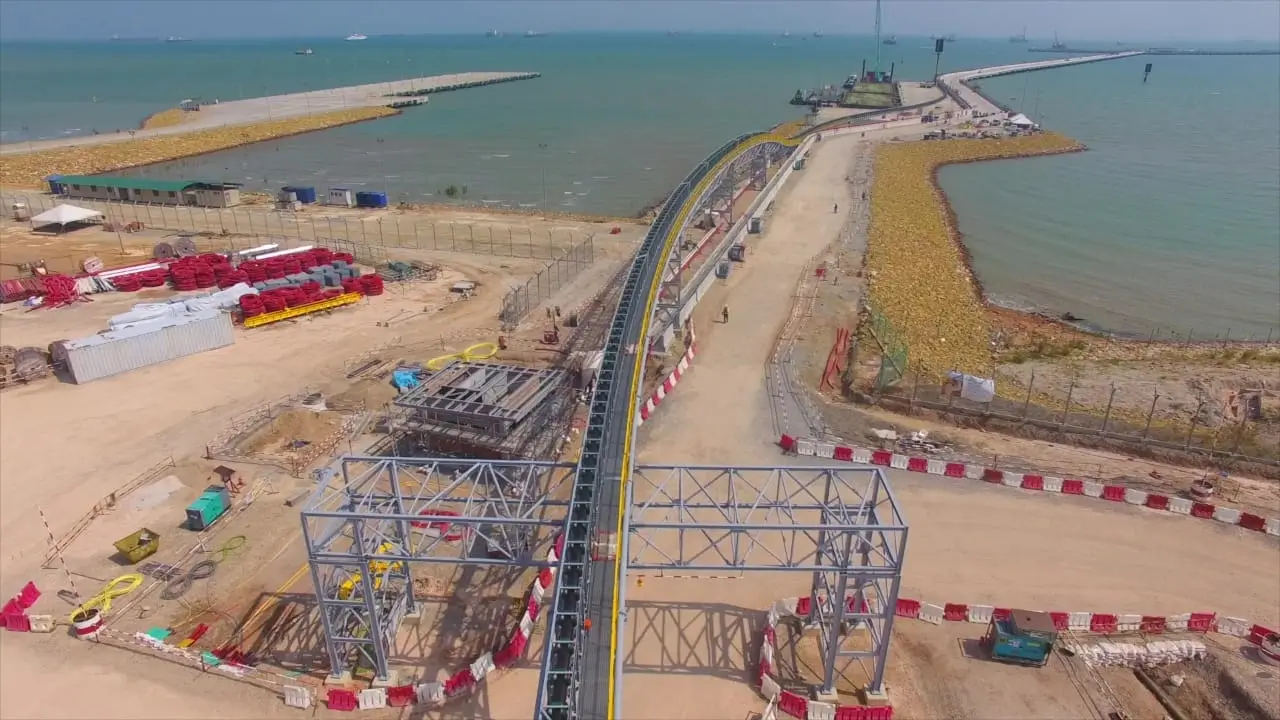
Port conveyor systems often run over water, over active road and rail corridors, and over working areas of the port where other operations are ongoing below. Spillage from conventional belt conveyors in these locations creates serious problems. Material falling into water is an environmental violation. Material falling on road and rail corridors is a safety hazard. Material falling on active working areas creates injuries and housekeeping costs.
Pipe conveyors eliminate spillage completely along the conveying route. So, pipe conveyors are the right choice for port conveyor routes that pass over sensitive or active areas. Methods India engineers pipe conveyor systems with appropriate structural supports for elevated routes in port environments, ensuring the system maintains safe clearances over active port infrastructure.
3. Handling Multiple Commodity Types
A port may handle several different bulk commodities across different seasons or different berths. Each commodity has different handling requirements. Some are dusty. Some are moisture-sensitive. Some are hazardous. A conventional belt conveyor designed for one commodity may not be suitable for another.
A pipe conveyor’s enclosed design makes it inherently more versatile across commodity types. The material is sealed inside the belt tube regardless of its properties. So, a pipe conveyor system at a port can handle coal during one season and fertilisers or sulphur during another, with the same level of dust control and zero spillage in both cases.
How Does Methods India Design and Deliver Pipe Conveyors?
Methods India does not supply pipe conveyors as a catalogue item. Every pipe conveyor system we deliver is custom-engineered for the specific application, site, material, and throughput requirements of the client. Here is how we approach pipe conveyor projects:
In-House Engineering: Methods India’s independent in-house design facility handles all engineering calculations, route design, belt selection, idler specification, drive system sizing, and structural design for pipe conveyor projects. We do not outsource the engineering. So, every pipe conveyor we deliver is designed by our own engineering team with full accountability for the design.
Proven Project Execution: Methods India has delivered pipe conveyor systems for demanding industrial applications, including the 2.1 km, 450 TPH sulphur export pipe conveyor for PETRONAS in Malaysia. This project required precise engineering for a hazardous material over a long distance with specific environmental and safety requirements. So, we have real-world proof of pipe conveyor delivery at industrial scale.
In-House Fabrication: All structural components, supporting structures, and mechanical elements of the pipe conveyor system are fabricated at Methods India’s manufacturing facility in Bangalore. Machine shop work, structural fabrication, and protective painting are all done in-house. So, quality control is maintained across every component before it reaches the site.
Turnkey Execution: Methods India delivers pipe conveyor systems on a complete turnkey basis. This includes engineering, fabrication, civil interface, erection, PLC and SCADA integration, commissioning, and handover. So, you deal with one team and one point of responsibility from the first engineering drawing to the day the pipe conveyor goes live.
ISO Certified Quality: Methods India’s manufacturing and execution processes are certified to ISO 9001:2015, ISO 14001:2015, and ISO 45001. Every pipe conveyor system we deliver is built and commissioned under documented quality standards.
Why Choose Methods India as Your Pipe Conveyor Partner?
Plants and port operators should choose Methods India as their pipe conveyor partner because of the combination we offer — 40+ years of bulk material handling experience, a proven pipe conveyor project in an internationally demanding application, in-house engineering and fabrication, and complete turnkey execution capability.
Experience: With over 40 years in bulk material handling across cement plants, mines, ports, power plants, and petrochemical facilities, Methods India understands the real-world demands of pipe conveyor systems in continuous-duty industrial environments.
Proven Track Record: Our 2.1 km sulphur pipe conveyor for PETRONAS in Malaysia is proof that Methods India can engineer and deliver pipe conveyor systems for demanding, high-stakes industrial applications at international standards.
Global Reach: Methods India has delivered bulk material handling systems across 36 countries. Our systems operate in diverse climatic conditions, across a wide range of industries, and under varying regulatory environments. So, we understand what it takes to deliver a pipe conveyor system that performs reliably in your specific location and application.
Single Point of Responsibility: From the first site visit to final commissioning, Methods India manages the entire pipe conveyor project in-house. So, there are no coordination gaps between engineering, fabrication, and erection teams. One team. One point of contact. One accountable partner.
Conclusion: Pipe Conveyors Are the Right Choice for Cement Plants, Mines, and Ports
Conventional belt conveyors are good systems for many applications. But when the material is dusty, hazardous, or moisture-sensitive, when the site layout is complex, when the route passes near residential areas or sensitive environments, or when spillage and dust emissions are regulatory concerns — pipe conveyors are the right answer.
Cement plants use pipe conveyors to transport limestone, clinker, and cement powder without dust and spillage. Mines use pipe conveyors to transport coal, ores, and hazardous materials safely across difficult terrain. Ports use pipe conveyors to handle bulk commodities in environmentally sensitive locations without generating dust or spillage over active port infrastructure.
Methods India stands out as a pipe conveyor manufacturer with 40+ years of experience, a proven international project track record, in-house engineering and fabrication, and complete turnkey execution capability. So, when you choose Methods India for your pipe conveyor project, you are choosing a partner who has done this before, at industrial scale, and delivered.
Contact Methods India today to discuss your pipe conveyor requirements. Let us help you engineer a dust-free, spill-free, enclosed conveying solution that keeps your plant, mine, or port running efficiently and in compliance.
FAQs
What are pipe conveyors and how are they different from conventional belt conveyors?
Pipe conveyors use the same basic belt conveyor principle, but the belt is rolled into a sealed tube around the material being transported. So, instead of material sitting on an open trough exposed to the environment, it is completely enclosed inside the belt tube from loading to discharge. This eliminates dust, eliminates spillage, and allows the belt to follow curves that a conventional belt conveyor cannot navigate without additional transfer points.
What materials are best suited for pipe conveyors?
Pipe conveyors are particularly well suited for dusty materials like limestone, coal, clinker, and cement powder; hazardous materials like sulphur and chemicals; and moisture-sensitive materials like fertilisers and finished cement. They are also the right choice for any material where environmental regulations or site conditions make dust or spillage from a conventional belt conveyor unacceptable.
Can pipe conveyors handle long distances and complex routes?
Yes. Pipe conveyors are specifically designed for long-distance and complex-route applications. Methods India delivered a 2.1 km pipe conveyor for PETRONAS in Malaysia. So, the system is proven over significant distances. Pipe conveyors can also negotiate both horizontal and vertical curves in a single continuous system, making them ideal for sites where the conveying route cannot follow a straight path.
Are pipe conveyors more expensive than conventional belt conveyors?
The upfront capital cost of a pipe conveyor is higher than a comparable conventional belt conveyor. But the total cost of ownership often works out lower. Pipe conveyors eliminate transfer points along the route, which removes the civil structures, drive systems, and maintenance requirements at those points. They eliminate spillage, which reduces housekeeping and material losses. And they eliminate the need for downstream dust collection equipment. So, the system-level cost comparison is more favourable to pipe conveyors than the equipment cost comparison alone.
How does Methods India approach pipe conveyor project execution?
Methods India delivers pipe conveyor projects on a complete turnkey basis. We handle all engineering in-house, fabricate all structural and mechanical components at our Bangalore facility, and manage erection, commissioning, and handover with our own teams. So, there is single-point accountability across the entire project from first engineering to final handover. Contact Methods India to discuss your pipe conveyor requirements.