

Slat Chain Conveyors: Complete Guide for Coal Handling & Bulk Material Systems in India
Slat Chain Conveyors play an important role in heavy-duty bulk material handling. They are especially useful where the loads are bulky, abrasive, hot or uneven to be moved with other conveyor systems. They are especially used in coal handling. Slat chain conveyors help maintain a steady and continuous flow of material across demanding plant conditions.
In this detailed guide, we explore what slat chain conveyors are, how they work, their advantages over other conveyor types, and and applications in coal and bulk material handling.At the end, we also make a detailed comparison between slat chain conveyors and belt conveyors to decide which conveyors are the best for heavy-duty industrial applications.
What are Slat Chain Conveyors?
Slat chain conveyors move products on a series of rigid slats attached to one or more chains. They are used for items that are too heavy, hot, irregular, oily, or unstable for a normal belt conveyor.The chains provide the driving force, while the slats provide a stable carrying platform.Therefore, the slat chain conveyor is useful when products need firm support rather than a flexible belt surface.
Methods India’s slat chain conveyors are suitable for heavy-duty transport. They can handle inclines, declines, curves, and accumulation zones. These conveyor slat systems can also be configured with multi-strand chains for higher torque requirements. They also have side guides for stability and powered transfers for seamless connection to other conveyors.
How Do Slat Chain Conveyors work?
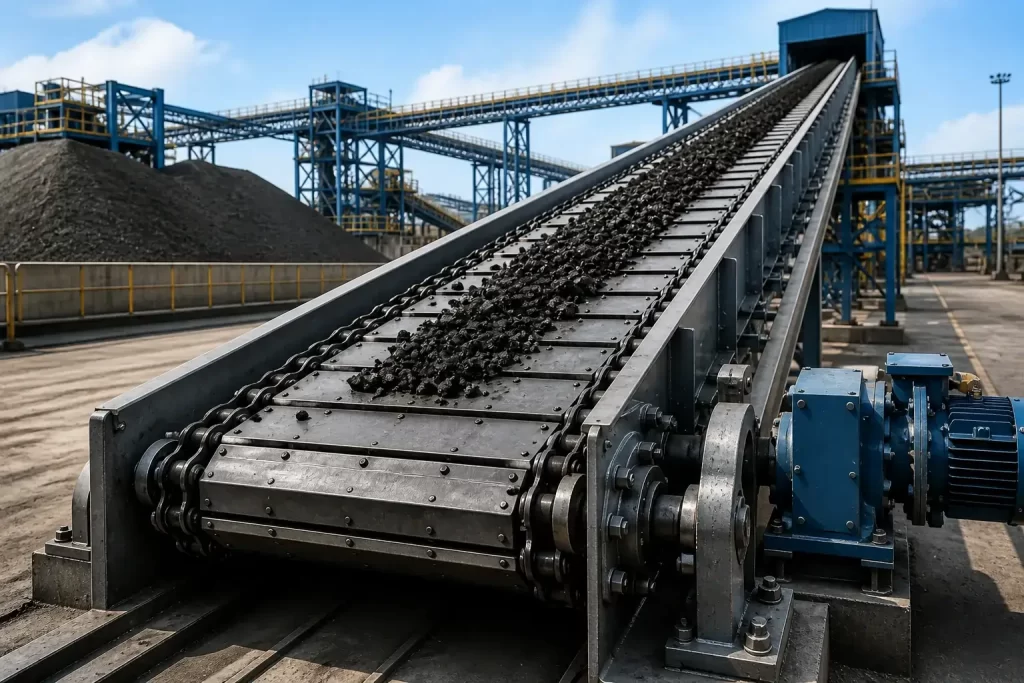
Slat chain conveyors use a motor-driven chain to pull rigid slats along a fixed track. The load sits directly on the slats, so the system can carry heavy, hot, or irregular items more reliably than a flexible belt conveyor. The drive motor turns a sprocket, and the sprocket engages the chain links to move the conveyor loop. As the chain moves, the attached slats travel across the top run and carry the materials forward.
After the material is discharged, the slats and chain return underneath the frame on the return path. This continuous path allows the conveyor to keep moving materials from one place to another without interruption. A typical slat chain conveyor includes slats, chains, sprockets, a frame and a drive unit. The slats form the carrying surface, the chains provide traction, and the sprockets convert motor power into motion. Guide rails or tracks, such as those in Methods India’s slat chain conveyors, keep the chain aligned and prevent sideways movement.
What are the applications of slat chain conveyors in coal handling systems?
Slat chain conveyors are suited for heavy-duty applications in coal handling because of their rugged chain and slat construction. Coal handling is a demanding bulk material handling application because coal can be abrasive, dusty, and heavy. Slat chain conveyors are especially suited for such harsh industrial environments where a strong conveying surface is needed, and belt wear would be a concern. Here are some of the detailed applications of the slat chain conveyors in coal handling:
1. Feeding crushers and screens to maintain a steady coal flow.
2. Transporting coal to storage bunkers before dispatch or further processing.
3. Moving coal to stockpiles for temporary storage.
4. Supplying coal continuously to power plant systems.
5. Loading coal onto trucks or railcars for distribution.
In coal handling systems, a slat chain conveyor may be positioned between the unloading,screening, crushing, storage, and loading sections. Its main application is to keep coal moving reliably between these points with minimal manual handling and fewer interruptions in the process.
What are the applications of slat chain conveyors in bulk material handling?
Methods India’s slat chain conveyors are used in bulk material handling where the load is heavy, hot, irregular or needs stable transport across complex conveyor paths. They are useful for heavy-duty transport across inclines, declines, curves and accumulation zones. This makes the system suitable for integrated plant material flow. Here are some of the detailed applications of slat chain conveyors in bulk material handling:
1. Foundry and Metal Plants
In foundries, slat chain conveyors are used for moving hot castings, heavy molds, metal scrap and abrasive parts. The solid slat and chain support help the conveyor survive impact and heat better than standard belt conveyor systems. Slat Chain Conveyors are useful between casting, cooling, trimming and inspection areas.
2. Automotive Plants
Automotive plants use slat chain conveyors for moving car bodies, chassis parts, engine components, gearbox assemblies and sub-assemblies. These items are often heavy, irregular in shape or need a stable base during movement. These are commonly placed in body construction, assembly, finishing, leak testing, and preservation areas. The main advantage of slat chain conveyors in automotive plants is smooth, controlled movement from one station to the next.
3. Heavy Manufacturing Plants
Heavy manufacturing uses slat chain conveyor systems for large parts, metal blocks, fabricated assemblies, and machine components. The conveyor’s rigid deck makes it suitable for moving items that would be too heavy or irregular for standard conveyor systems.
4. Cement Plants
Slat chain conveyors are used in cement plants because these plants demand heavy-duty bulk material handling of abrasive, dusty materials in large volumes. The chain slat conveyors are especially useful for transferring raw materials, alternative fuels, clinker-related loads, and packaged or semi-processed materials. They are placed between process stages,storage points, and loading zones.
These are just a few of the many applications of slat chain conveyors. These robust conveyor systems are used everywhere where heavy bulk material handling is involved. They provide a strong, flat and stable moving base designed to handle heavy, unstable and uneven materials.
What are the advantages of Slat Chain Conveyors over other conveyor types?
Slat Conveyors have several advantages over belt, roller and simple chain conveyors. They provide better stability for loads which are heavy, irregular, hot or need precise positioning. Here are some of the advantages of slat chain conveyor over other conveyor variants:
1. Better Stability
In slat chain conveyors, the load rests on rigid slats that form a continuous surface. The surface spreads the load across multiple chain points, which helps the conveyor keep its shape underweight and during start-stop movement. Slat chain conveyors are especially useful for heavy, irregular, or awkward loads. A flexible belt can sag or track unevenly. Slats, on the other hand, hold the load more like a moving platform, improving balance and positioning. The interlocking slats create a continuous carrying deck, so the product has a larger and firmer contact area. This reduces slippage and makes the conveyor less sensitive to vibration, impact, and load shift.
How does Methods India ensures stability in their slat chain conveyors?
● A rigid slat surface that reduces sagging, wobble and load shift. This is especially when the conveyor carries heavy, hot, palletised, or irregularly shaped materials.
● Side guides that keep the material centred on the conveyor and reduces side ways movement. This is useful on curves, inclines and decline sections.
● Multiple-strand chains for high torque requirements distribute the load more evenly and help the conveyor remain stable under stress.
● Smooth powered transfers reduce jolting, misalignment and product disturbance when the material moves from one conveyor to another.
2. Better Performance in Harsh Conditions
In bulk material handling, industrial conveyors often have to operate under harsh conditions. Slat chain conveyors keep working reliably even in hot, dusty, abrasive, wet and vibration-heavy conditions due to their rigid construction and chain-driven design.
How Methods India ensure better performance in harsh conditions in their slat chain conveyors?
● Corrosion-resistant steel frames help the conveyor resist rust in wet, humid, or outdoor plant conditions.
● Protective coatings improve surface durability and reduce wear from harsh mining and power-plant environments.
● Strong welds and tight fabrication tolerances keep the structure rigid under shock loads and continuous vibration.
● Precision-engineered rollers and low-friction design reduce drag, heat buildup, and edge damage.
3. Suitable For Curves and Complex Plant Layout
Slat chain conveyors are built to especially follow curved paths, inclines, declines and tight space routes. This makes them suitable for plants where equipment cannot be moved in a simple straight line.
How does Methods India customise to complex plant layouts?
Methods India provides custom-designed conveyor systems designed for specific plant layouts and harsh operating conditions.
● Side guides help keep the load centred while the conveyor changes direction, reducing drift at turns.
● Multi-strand chains help the slat chain conveyors handle higher torque and keep the drive stable when the layout becomes more demanding.
● Powered transfers let the load move swiftly from one section to another without abrupt jolt points. This improves flow in complex plant layouts where the line must bend, split, merge, or connect multiple stations.
4. Lower Product Damage and Spillage
Slat chain conveyors ensure lower product damage by keeping the load stable, centered and smoothly transferred from one section to the next. In slat chain conveyors, the load sits on a rigid, continuous surface instead of a flexible moving belt. This avoids wobbling and slipping when the slat chain conveyor is running.
These conveyor slat chain systems also reduce shock at transfer points when the system is designed for smooth handover between conveyor sections. A smoother transfer reduces the chances of the material getting dropped, bumped, or misaligned as they move through the conveyor.
How does Methods India slat chain conveyors reduce product damage and spillage?
● A rigid carrying surface ensures that materials are less likely to slip, bounce, tilt or break during movement. The interlocking slats create a continuous surface that supports the load more evenly.
● Application-specific designs match the conveyor slat chains to the material being carried.When the conveyor is properly sized and configured, the material experiences less shock and less rubbing at transfer points, which reduces surface damage and breakage.
● Sealed structures, controlled transfer points, dust-controlled chutes, and proper guarding help keep the material flow inside the flow path.
● A stable slat deck and guided movement help keep the load centered. That means less material escapes sideways, fewer particles drop off at transitions, and the overall handling line stays cleaner.
5. Precise Control
Slat Chain Conveyors keep spacing, alignment and orientation consistent while the load passes through several stages of the plant. The chain driven loop also gives a more controlled movement pattern which improves repeatability from one cycle to the next.
Methods India with their application specific customised designs offer better control over the material being moved. A slat chain conveyor that is sized and configured accurately offers proper control because it matches the load and the plant flow. This is especially important Controlled movement reduces the chance of product shift, spill or irregular flow as the material moves through the plant.
6. Better Handling of Irregular or Difficult Loads
Irregular loads have uneven weight and hence their center of gravity shifts. Their shape does not sit well with a flexible surface like that of a belt conveyor where they can wobble, slip, tip or even jam the conveyor. The loads may often fall off in curves, inclines or declines.
Slat chain conveyors are less dependent on surface friction and belt tension, so they handle awkward loads more confidently. They provide a much better full surface support compared with simple roller conveyor systems which is important for small, unstable or irregularly shaped items. Methods India’s conveyor slat chains are built for heavy, hot, palletised and irregularly shaped loads. Their rigid slats, chain-driven and side guides create a stable platform that keeps material supported throughout the travel path.
Slat Chain Conveyor vs Belt Conveyor: Which Is Better for Heavy-Duty Industrial Applications?
Slat chain conveyors are the better choice than belt conveyors when it comes to heavy-duty industrial applications. Belt conveyors are better for lighter, faster, and more general-purpose transport. When the application involves heavy loads, harsh conditions,irregular shapes, curves, or controlled transfers through multiple plant sections, slat chain conveyors should always be your preference. Here is why:
● Slat chain conveyors are designed to carry very heavy, bulky and irregularly shaped items without losing stability. Their rigid slats create a strong surface that supports concentrated loads well. Therefore they are used when products are too heavy or too rough for conveyor belt systems. Belt conveyors on the other hand are suited for uniform flat bottomed medium to light weighted items which are easy to carry on a flexible surface.
● Slat chain conveyors offer better support in demanding industrial environments. When materials are too hot,abrasive or difficult to control, slat chain conveyor systems are used. The materials may be too hot causing belt wear and tear. Slat chain conveyor systems handle this better because they have a more rugged mechanical structure and a strong carrying surface.
● Slat chain conveyors also offer better stability. These conveyor slat systems are especially useful when the load needs to stay in position during movement. This is applicable for hot, heavy items and loads with uneven weight distribution. Belt Conveyors can move materials smoothly, but they do not provide the same rigid support for heavy or unstable loads. This is why slat chain systems are often preferred when there is a need for controlled transfer, indexing or station to station movement.
Why Choose Methods India?
Methods India stands out for its bulk material handling equipment, including slat chain conveyors. We have over 40 years of experience in manufacturing high-quality bulk material handling solutions. This has helped us to identify the challenges plants face in the movement of loads of various sizes, quantities and dimensions. Therefore, at Methods India, we offer
customised bulk material handling equipment and application-specific conveyor designs. Here are some of the reasons why you should choose Methods India:
1. Turnkey Execution of Bulk Material Handling Equipment
At Methods India, we offer complete turnkey execution of our bulk material handling systems.This means that the entire structural conceptualisation, designing, development, fabrication, and execution happens under one roof. This helps us to customise our bulk material handling equipment, including slat chain conveyors, according to the plant layout, material being lifted, frequency of operations, etc. Therefore, the plant does not have to face challenges later. Our conveyor designs are application-specific. We offer a wide range of conveyor systems suited to different plants and different applications. This gives you a lot of options to choose from and fulfill your bulk material handling needs.
2. 40+ Years of Bulk Material Handling Excellence
Methods India has been manufacturing bulk material handling equipment for coal mines, sugar mills, cement and power plants, etc., for more than 40 years. We clearly understand the challenges plants face without proper bulk material handling equipment. Therefore, all our equipment, including slat chain conveyors, is designed to address all those challenges and generate higher throughput.
3. Highly Efficient and Safe Bulk Material Handling Equipment
Methods India offers robust bulk material handling equipment, including slat chain conveyors designed for the continuous lifting and movement of heavy loads. These systems are built for demanding industrial environments where reliability, strength, and long service life are essential.Our components are dust-proof, weather-resistant, and corrosion-resistant, which helps improve equipment life and performance in harsh operating conditions. The enclosed design of our conveyors further protects the system from external contamination and supports cleaner, safer operation. All moving parts are protected with safety enclosures and smooth transfer points,which helps reduce wear and improves material flow. We also use abrasion-resistant belts and belt alignment sensors to minimise belt wear and tear while ensuring accurate alignment during material handling. For added safety and control, our conveyors include emergency stop buttons and PLC-based automation. These features improve operational safety, reduce manual intervention, and support efficient plant performance. Our high-quality bulk material handling systems are used in coal mines, cement plants, power plants, sugar mills, and other industrial facilities that require continuous bulk material movement. This makes Methods India a dependable choice for industries that need durable, efficient, and low-maintenance conveying
solutions.
4. Compliance and Export
Our bulk material handling equipment follows strict adherence to ISO 9001:2015, ISO 14001:2015, and ISO 45000:2018 standards. This helps in ensuring compliance during audits and smooth inspections. These certifications reflect our commitment to quality management, environmental responsibility, and workplace safety.
With a global presence with product installations in more than 36 countries, we bring proven international experience to every project. This commitment to quality and compliance ensures that we deliver export-grade equipment that meets international requirements for your plant.
Conclusion- Slat Chain Conveyors
Slat chain conveyors are a strong choice for heavy-duty industrial applications. They handle heavy, irregular, and difficult loads with better stability and control than many other conveyor types. They also perform well in harsh conditions, complex layouts, and bulk material handling systems. For industries like coal handling, power plants, cement, sugar, and mining, they offer reliable and efficient material movement. Methods India’s customised slat chain conveyor systems make these benefits even more effective by matching each conveyor to the plant’s exact needs. Visit our website for our projects and more details.