

Pipe Conveyor Belt Systems vs. Traditional Conveyors: Which One is Right for You?
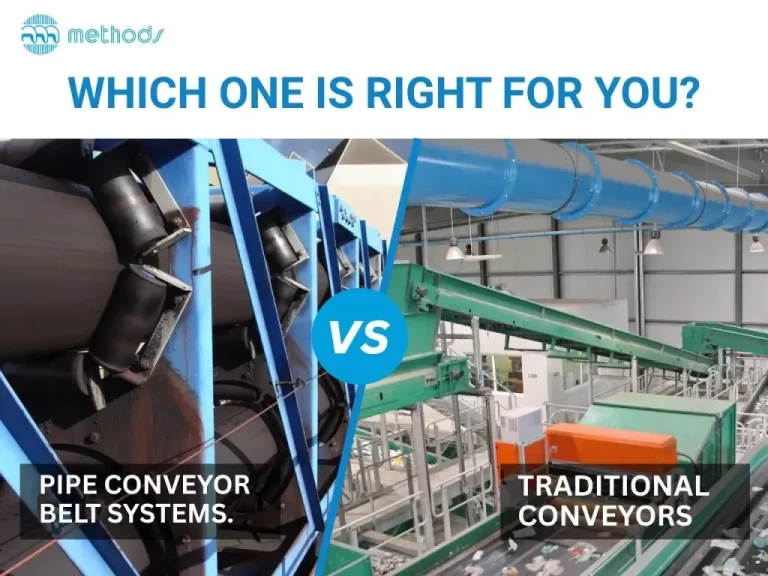
Your operational efficiency, cost-effectiveness, and compliance with environmental regulations can all be greatly impacted by the conveyor system you choose when moving bulk materials in sectors like cement, power, mining, ports, and agriculture. Although conventional conveyors have long been the preferred option, Pipe Conveyor Belt Systems have become a clever and adaptable substitute in recent years.
What distinguishes the two, then? More importantly, which one is best for your company? To help you make an informed choice, we compare pipe conveyor belt systems vs traditional conveyors in this blog post based on important criteria like suitability, performance, energy efficiency, and design.
What Are Pipe Conveyor Belt Systems?
An advanced form of conveying solution is the Pipe Conveyor Belt System, in which idler rollers form the belt into a closed tubular shape. The pipe conveyor belt encloses the material, avoiding spills, dust emissions, and material contamination, in contrast to flat belt conveyors that run in an open trough.
These systems are ideal for:
- Long-distance transportation.
- Challenging terrains or curves.
- Environmentally sensitive zones.
- Materials requiring enclosed handling.
Also Read: Innovative Pipe Conveyors: Transforming Material Handling Efficiency
Pipe Conveyor vs. Traditional Conveyor: Key Comparisons
Let’s take a deeper look at how pipe conveyors compare with traditional belt conveyors across key parameters:
| Criteria | Pipe Conveyor Belt Systems | Traditional Conveyors |
| Design | Enclosed tubular design; adaptable to sharp curves and elevation changes | Open, flat belt system; better for straight-line layouts |
| Material Spillage | Zero spillage due to enclosed system | Higher risk of spillage, especially with fine or sticky material |
| Dust Control | Excellent – prevents dust escape entirely | Requires additional dust suppression systems |
| Environmental Impact | Lower – prevents leakage and reduces carbon footprint | Higher – may require more energy and cleaning infrastructure |
| Maintenance | Slightly higher due to specialized components | Easier and less frequent maintenance |
| Cost | Higher initial investment, but lower long-term operational costs | Lower upfront costs, potentially higher long-term expenses |
| Aesthetic/Regulatory | Ideal for urban or sensitive installations (e.g., near residential areas) | Less suitable for strict environmental compliance zones |
When Should You Choose Pipe Conveyor Belt Systems?
You should consider installing a pipe conveyor system if your operations:
- Require long-distance or cross-country conveying.
- Involve hazardous, dusty, or sticky materials.
- Are located in residential, environmentally sensitive, or curved terrains.
- Demand clean and spillage-free transport.
- Need to comply with stringent environmental regulations.
Pipe conveyors are widely used in cement plants, power stations, ports, and fertilizer units, where dust control and enclosed conveying are essential for safe and efficient operations.
The Methods India Advantage:
At the forefront of advanced material handling is Methods India Pvt. Ltd., a leading player in designing and executing customized pipe conveyor belt systems across India and globally. With over 40 years of engineering excellence, Methods India offers:
- Turnkey solutions – from design and fabrication to installation and commissioning.
- 100% in-house manufacturing – ensuring quality control and on-time delivery.
- Proven expertise in pipe conveyors, overland systems, and complex terrain layouts.
- Strong focus on innovation, sustainability, and client-specific performance.
Their solutions are trusted by major industrial clients across sectors like cement, sugar, mining, and energy.
Final Thoughts: Which Conveyor System is Right for You?
A conventional conveyor system might be adequate if your material handling requirements are simple, indoors, or budget-conscious. However, Pipe Conveyor Belt Systems are the best option if you’re looking for sophisticated, hygienic, and effective bulk material transportation, particularly over long distances or over challenging terrain.
You can create a system that not only satisfies your present requirements but also gets your company ready for future operational and environmental standards with the help of a qualified partner like Methods India.
FAQs
What are the main differences between pipe conveyor belt systems and traditional open belt conveyors?
Pipe conveyor belt systems use an enclosed tubular belt that prevents material spillage and dust emissions, while traditional belt conveyors run in an open trough and are more prone to dust, spillage, and contamination. Pipe conveyors also handle curves and elevation changes more effectively.
How does a pipe conveyor system improve dust control compared to traditional conveyors?
Pipe conveyor systems keep material fully enclosed inside a tubular belt, preventing dust escape and reducing the need for extra dust suppression equipment. Traditional open conveyors often require additional covers or dust control systems to manage emissions.
Are pipe conveyor belt systems more energy-efficient than traditional conveyors?
Pipe conveyors can be more energy-efficient for long-distance or complex routes because their enclosed design reduces air resistance and eliminate the need for multiple transfer points, which in turn lowers power consumption over time.
Do pipe conveyor systems cost more than traditional belt conveyors?
Pipe conveyor systems generally have higher upfront costs due to the specialized enclosed belt and idler configuration, but they can save money long-term through reduced material loss, lower dust control expenses, and fewer transfer points compared to traditional systems.
How does maintenance differ between pipe conveyors and traditional conveyors?
Pipe conveyors may require specialized maintenance due to their enclosed structure and idler design, but they also reduce wear from environmental exposure and material spillage, which can lower long-term maintenance needs compared to traditional open systems.