

How to Choose the Right Cross Country Conveyor for Bulk Material Transport
Moving bulk material over long distances is one of the biggest operational challenges in mining, cement, power, and steel industries. Trucks are expensive to run and hard to scale. Manual handling is not practical at industrial volumes. This is where a cross country conveyor becomes the right solution.
A cross country conveyor transports bulk material continuously over long distances, from a mine face to a processing plant, from a quarry to a cement plant, or from a port to a stockpile. When designed and built correctly, it replaces an entire fleet of haul trucks and does the job more efficiently, more safely, and at a lower operating cost.
But choosing the right cross country conveyor for your operation is not straightforward. Every site is different. The material, the distance, the terrain, and the throughput requirements all play a role in determining what kind of system you need. This blog walks you through every major factor to consider so you can make the right decision.
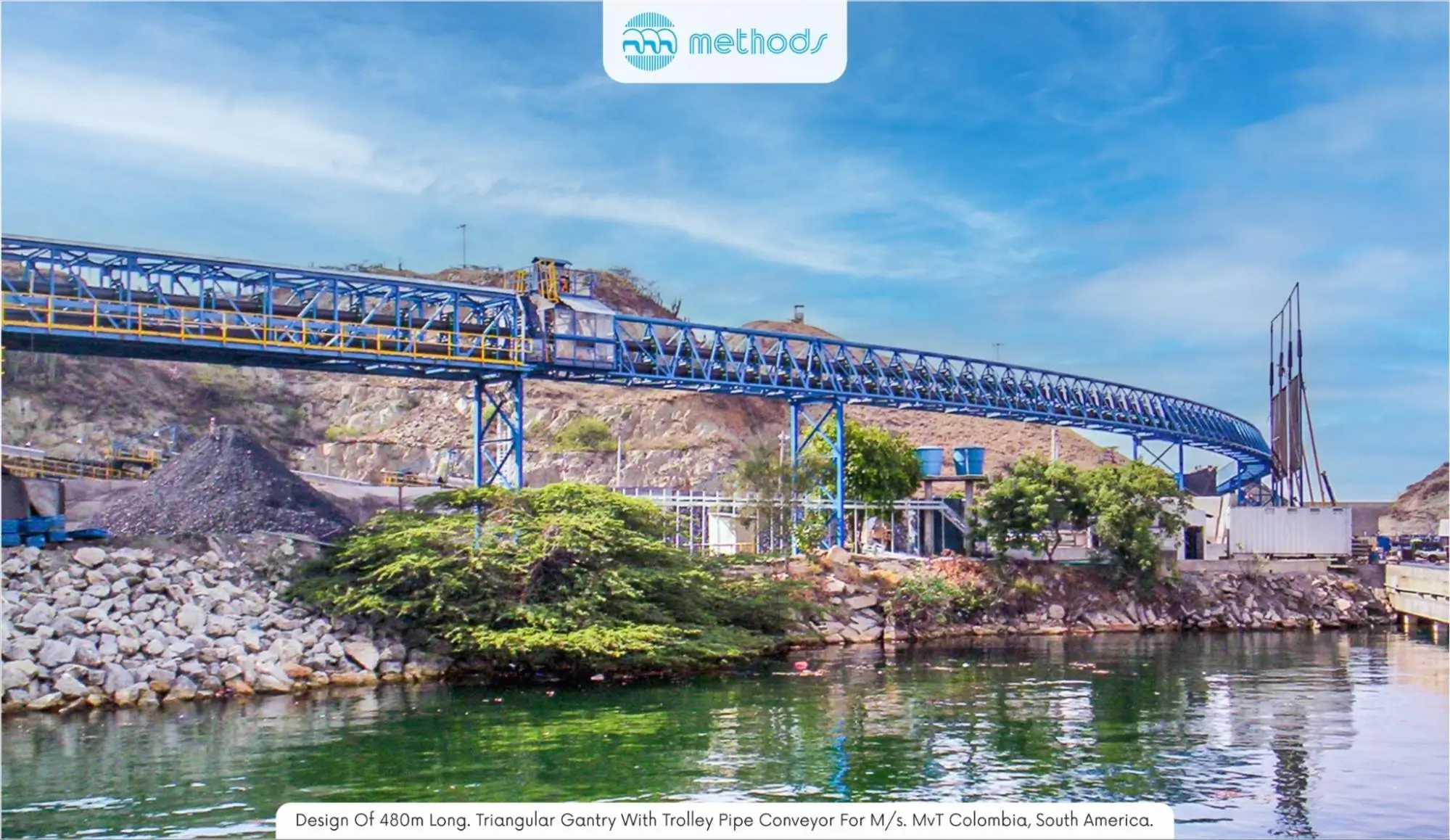
What is a Cross Country Conveyor and Why Does It Matter for Bulk Material Transport?
A cross country conveyor is a long-distance belt conveyor system designed to move large volumes of bulk material across open terrain. It can span distances from a few hundred meters to several kilometres. Unlike conveyors installed inside a plant or warehouse, cross country conveyors traverse natural terrain including hills, valleys, uneven ground, and areas where roads or infrastructure do not exist.
They are used in industries where material has to move between two points that are far apart. In mining, they connect the extraction site to the processing plant or stockyard. In cement, they connect the limestone quarry to the kiln. In power plants, they move coal from the unloading point to the boiler house.
The reason cross country conveyors matter is simple. Moving bulk material by truck over long distances is expensive. Fuel, drivers, tyre wear, road maintenance, and vehicle downtime all add up. A well-designed cross country conveyor runs continuously, requires far less manpower, consumes significantly less energy per tonne of material moved, and does not depend on road conditions.
Methods India has been designing and building cross country conveyor systems for over 40 years. Our systems connect mines, quarries, plants, and ports across India and in 36 countries globally. We build cross country conveyors up to 5 km in length using modular bolted structures that can navigate even challenging terrains.
Factor 1: Know Your Material Before Choosing a Cross Country Conveyor
The material you want to transport is the first and most important factor in selecting the right cross country conveyor. The wrong belt, wrong idler spacing, or wrong structural load rating can cause breakdowns, belt damage, and material spillage.
Here is what you need to know about your material before any design work begins.
Bulk Density-Materials like coal, limestone, iron ore, and bauxite all have very different bulk densities. A conveyor carrying iron ore needs to be far more robust than one carrying coal at the same belt speed. The structural frame, drive power, and belt tensile strength must all be calculated based on the actual density of your material.
Lump Size-Large lumps of ore or rock put impact load on the belt and idlers at the loading point. If your material comes directly from a crusher or a mine face, the maximum lump size must be factored into the belt width and idler selection. Oversized lumps that exceed the belt’s capacity will cause belt damage and frequent unplanned stops.
Abrasiveness-Highly abrasive materials like quartz, silica, iron ore, and slag wear out conveyor belts faster. For abrasive materials, the belt cover grade and rubber compound must be selected carefully. Using a standard-grade belt on highly abrasive material will result in premature belt failure and high replacement costs.
Moisture content-Wet or sticky materials behave differently on a conveyor belt. They can stick to rollers and pulleys, causing belt drift and carryback. If your material has high moisture content, you need the right belt surface, the right cleaning systems, and transfer chutes designed to prevent buildup.
Dustiness-Fine and dusty materials like cement, fly ash, or coal fines require enclosed conveyor systems. An open belt conveyor will generate dust that creates air quality problems, environmental non-compliance, and material loss. For these materials, a pipe conveyor is often the better cross country conveyor solution.
Methods India engineers always conduct a detailed material analysis before designing any cross country conveyor system. Getting this right at the start avoids expensive design changes and operational problems later.
Factor 2: Conveying Distance and Elevation Change in Cross Country Conveyor Selection
Distance and terrain are the two defining factors in the structural and mechanical design of a cross country conveyor. They determine drive power, belt tension, structural support requirements, and the number of drives needed.
Conveying Distance-Longer conveyors require higher belt tension because the belt must pull itself along its entire length while also carrying the material load. As distance increases, higher tensile-strength belts are needed. Steel cord belts are used on long cross country conveyors because they offer much higher tensile strength and lower elongation compared to fabric belts. The drive motors and gearboxes must also be matched to the length and load.
Elevation Changes-If the conveyor runs uphill, the drive must overcome both the horizontal travel resistance and the vertical lift. If it runs downhill, the system may actually generate power. Downhill cross country conveyors require regenerative drives that feed energy back into the grid, which reduces operating costs significantly.
Vertical and Horizontal Curves- Cross country conveyors often cannot run in a straight line. They navigate the natural terrain using carefully engineered vertical and horizontal curves. The geometry of these curves must be calculated precisely. Incorrect curve design leads to belt lifting off idlers, edge wear, and structural stress.
Methods India’s engineering team uses detailed topographic survey data to design cross country conveyor routes that minimise civil work while staying within safe belt curve limits. Our in-house Independent Design House handles all structural and mechanical calculations for each project.
Factor 3: Throughput Capacity Requirements and Belt Speed for Your Cross Country Conveyor
Knowing how much material you need to move per hour determines the belt width and belt speed of your cross country conveyor. These two parameters are directly linked and must be balanced carefully.
Higher throughput can be achieved by increasing belt width, increasing belt speed, or both. However, each has limits. Higher belt speeds on abrasive materials accelerate belt and idler wear. Wider belts increase the structural load and require wider support structures and heavier civil foundations.
As a starting point, here is how throughput capacity typically maps to belt width in cross country conveyor applications.
For throughputs below 500 tonnes per hour, belt widths of 800 mm to 1000 mm are typically used. For 500 to 2000 tonnes per hour, belt widths of 1000 mm to 1400 mm are standard. For very high-capacity applications above 2000 tonnes per hour, belt widths of 1600 mm and above are used, often combined with higher belt speeds.
Getting the throughput calculation right also requires understanding the bulk density and troughing angle of the material. Methods India designs cross country conveyor systems around actual throughput requirements, not just theoretical maximum belt capacity, so the system is sized correctly for your real operational demands.
Factor 4: Choosing Between Open Belt and Pipe Conveyor for Cross Country Material Transport
One of the most important decisions in cross country conveyor selection is whether to use a conventional open troughed belt conveyor or a pipe conveyor. Both can transport material over long distances, but they are suited to different conditions.
Open belt cross country conveyors are the most common and cost-effective choice for materials that are not dusty, not prone to spillage, and where environmental regulations around dust are manageable. They are easier to maintain, simpler to load, and have lower capital cost compared to pipe conveyors. They work well for large, non-dusty materials like limestone, ore, and aggregate in open environments.
Pipe conveyors are the right choice when the material is fine, dusty, or environmentally sensitive. The belt is curled into a closed tube after loading, completely enclosing the material for the entire length of the conveyor. This prevents dust, spillage, and material contamination. Pipe conveyors can also negotiate tighter horizontal and vertical curves than open belt conveyors, which makes them useful on sites where the terrain is complex.
Methods India manufactures both open belt cross country conveyors and pipe conveyor systems. Our pipe conveyor systems are especially suited to cross country applications in cement, coal, and chemical industries where dust control is critical.
Factor 5: Structural Design and Civil Requirements for a Cross Country Conveyor
The structural support system of a cross country conveyor must be designed to handle the weight of the belt, material, and all dynamic loads across the entire conveying route. This includes wind loads, seismic loads depending on the location, and the varying loads that occur during starting, stopping, and emergency braking.
Support Structure Type-In flat terrain, ground-supported steel trestles at regular intervals are the most common structure. In hilly or uneven terrain, elevated structures on concrete foundations or pile foundations are used. In some cross country conveyor projects, gallery-style enclosed structures are used where additional weather protection is needed.
Span Between Supports-Wider idler spans reduce the number of support structures and civil foundations, lowering capital cost. But the span must stay within the safe deflection limits of the belt and must account for material load and wind load. Optimising the span requires structural calculations for each individual section of the route.
Civil and Foundation Work-Every support structure requires a foundation. In open terrain, this can involve significant earthwork, especially in rocky or waterlogged ground. Methods India uses modular bolted steel structures that are quick to erect and can be adjusted on site to suit local ground conditions. Our erection and commissioning team handles all site work from foundation marking to final alignment.
Factor 6: Drive System and Control Automation for Cross Country Conveyors
The drive system is the engine of any cross country conveyor. Selecting the right drive configuration is critical for reliable, energy-efficient operation.
Single Drive vs. Multiple Drives-Short cross country conveyors can be operated with a single drive at the head end. Longer conveyors require intermediate or tail end drives to distribute the belt tension more evenly and avoid overloading the belt. The number and placement of drives is determined by the belt tension analysis for the specific route.
Soft Starters and Variable Frequency Drives-Starting a long, heavily loaded cross country conveyor puts enormous stress on the belt and mechanical components. Soft starters and Variable Frequency Drives (VFDs) allow the belt to accelerate slowly, reducing starting shock loads. VFDs also allow the belt speed to be adjusted based on the actual material feed rate, which saves energy when throughput is below maximum.
PLC and SCADA Automation-A modern cross country conveyor is monitored and controlled through PLC-based automation. Belt speed, motor current, belt alignment, material load, and temperature sensors all feed into a central control system. Alarms and automatic shutdowns protect the conveyor from belt mistracking, overload, blockages, and motor faults.
Methods India integrates PLC-based control systems across all our cross country conveyor projects. Our systems include belt alignment sensors, speed sensors, pull cord emergency stops at regular intervals, and remote monitoring capability. This gives operators full visibility of system performance from a central control room.
Factor 7: Maintenance Access and Spare Parts Planning for Cross Country Conveyors
A cross country conveyor that runs for several kilometres in open terrain presents unique maintenance challenges. Components will need to be replaced. Belts will need to be inspected. Access roads, lighting, and maintenance platforms must be planned into the design from the start.
Access Roads-Maintenance vehicles must be able to reach every section of the conveyor. In remote mine sites or cross-country terrain, dedicated access roads alongside the conveyor are essential. These should be factored into the civil planning budget.
Critical Spare Parts-The components that wear and need regular replacement in a cross country conveyor include idler rollers, belt cleaning blades, pulleys, and drive components. A critical spare parts inventory should be maintained on site to avoid long shutdowns when components fail.
Idler Spacing and Replacement-Idler rollers carry the weight of the belt and material continuously. On long cross country conveyors, there can be thousands of idlers. Selecting the right idler class and spacing reduces replacement frequency. Methods India uses heavy-duty idler sets with sealed bearing assemblies that extend service life in dusty and wet operating environments.
Methods India provides after-sales support for all conveyor systems we supply. Our service network covers major cities across India and we supply genuine spare parts with fast turnaround to minimise plant downtime.
Factor 8: Why Choosing the Right Cross Country Conveyor Partner Matters
Choosing the right cross country conveyor system is only half the decision. The other half is choosing the right partner to design, build, and commission it.
A cross country conveyor system is a long-term asset. It will operate for 15 to 25 years. Poor design decisions made at the beginning will cost far more to fix later than they would have cost to get right the first time. The company you choose must understand terrain challenges, material behaviour, drive engineering, structural design, and automation. They must be able to handle the complete scope in-house.
Methods India offers complete turnkey execution for cross country conveyor projects. Our Independent Design House handles all engineering and structural calculations. Our 1,80,000 sq. ft. fabrication facility with over 450 employees builds every component in-house. Our erection and commissioning team handles installation and final system testing on site.
We have installed cross country conveyor systems for mining companies, cement manufacturers, steel plants, and power projects across India and internationally. Our systems are ISO 9001:2015, ISO 14001:2015, and ISO 45001:2018 certified.
If you are evaluating a cross country conveyor for your bulk material transport requirement, visit our website and get in touch with our team. We will assess your site, material, and throughput requirements and design a system that works reliably from day one.
Conclusion: Get the Cross Country Conveyor Selection Right from the Start
Choosing the right cross country conveyor for bulk material transport is a decision that affects your operational costs, safety performance, and production continuity for many years. The key factors — material characteristics, distance, elevation, throughput, belt type, structural design, drive configuration, and maintenance access — all need to be evaluated together. No single factor works in isolation.
Getting one factor wrong can compromise the entire system. The belt may wear out prematurely. The drives may be undersized. The structure may not handle wind loads. The belt may drift on curves. All of these problems are avoidable with the right engineering and the right partner.
Methods India has 40 years of experience designing and building cross country conveyor systems that perform reliably in demanding industrial environments. Our end-to-end capability in design, fabrication, installation, and commissioning means you deal with one accountable partner from concept to commissioning. Contact us to discuss your cross country conveyor requirements.
FAQs
What is a cross country conveyor?
A cross country conveyor is a long-distance belt conveyor system designed to transport bulk material across open terrain between two points. It is used in mining, cement, power, steel, and aggregate industries to replace or reduce haul truck operations over long distances.
What materials can a cross country conveyor transport?
Cross country conveyors can transport a wide range of bulk materials including coal, iron ore, limestone, bauxite, copper ore, aggregate, clinker, fly ash, and biomass. The belt type, cover grade, and structural design are selected based on the specific material characteristics.
How long can a cross country conveyor be?
Cross country conveyors can span from a few hundred metres to several kilometres. Methods India builds cross country conveyor systems up to 5 km in length. For very long routes, multiple conveyors in series with intermediate transfer stations are used.
What is the difference between a cross country conveyor and a pipe conveyor?
A conventional cross country conveyor uses an open troughed belt to carry material. A pipe conveyor curls the belt into a closed tube after loading, completely enclosing the material. Pipe conveyors are used when dust control is critical, when the material is fine or environmentally sensitive, or when the route includes tight horizontal or vertical curves.
How is the throughput capacity of a cross country conveyor determined?
Throughput capacity is determined by the belt width, belt speed, material bulk density, and troughing angle. A detailed capacity calculation is required for each project to ensure the conveyor is sized correctly for the actual material and operational conditions.
Does Methods India handle the complete cross country conveyor project?
Yes. Methods India provides complete turnkey execution including engineering design, in-house fabrication, supply, erection, and commissioning. Our Independent Design House handles all structural and mechanical calculations and our fabrication facility manufactures all major components in-house.