

How to Calculate Conveyor Pulley Diameter and Face Width
Conveyor pulley diameter and face width are two of the most critical sizing decisions in belt conveyor design. Get either wrong, and you risk belt mistracking, premature wear, edge damage, or drive failure. This guide walks through the exact formulas, worked examples,and design factors engineers use to size pulleys correctly.
What Is Pulley Face Width and Why Does It Matter?
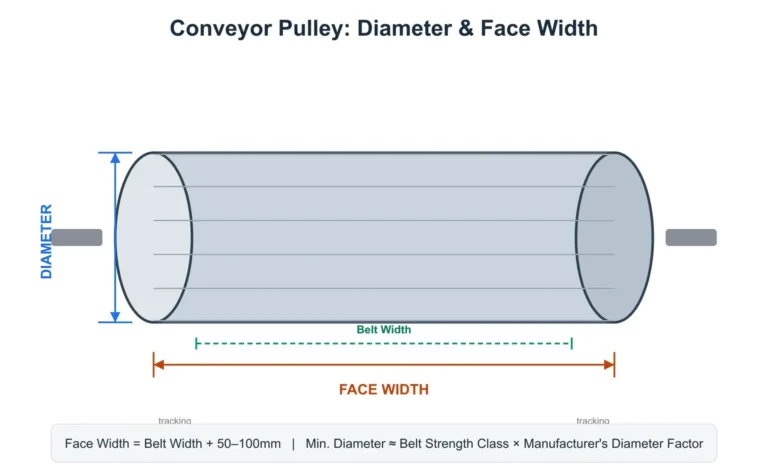
Pulley face width is the width of the pulley shell measured across its cylindrical body, not including the shaft or end discs. It must be wider than the belt itself to prevent the belt edges from running off the pulley face during tracking adjustments or minor misalignment. If face width is too narrow, the belt edges hang off the pulley and wear rapidly. If it’s too wide,you add unnecessary weight, cost, and bearing load without any functional benefit.
What Is Pulley Diameter and Why Does It Matter?
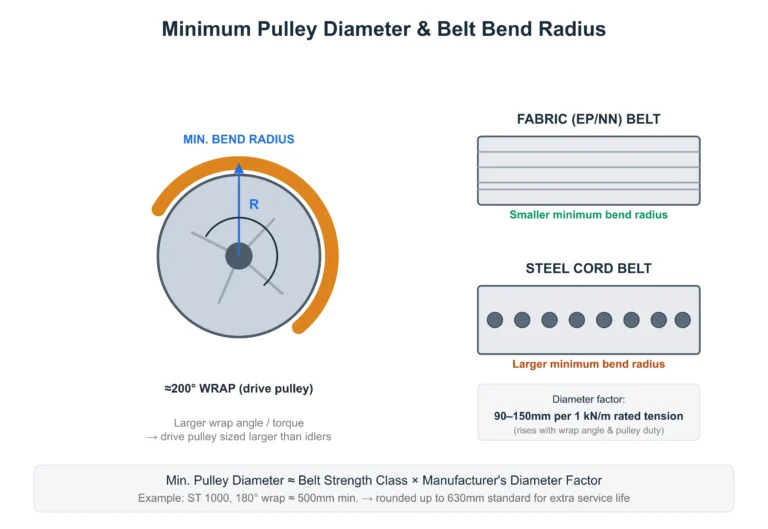
The diameter of the pulley is the outside diameter of the pulley shell. It is the bending radius the belt undergoes when wrapping around the pulley. Every belt has a minimum bend radius it can tolerate before internal damage occurs like carcass cracking in fabric belts, or cord fatigue in steel-cord belts.
Diameter also affects drive torque requirements: a smaller diameter needs more torque to transmit the same tension, which is why drive pulleys are often sized larger than idler pulleys carrying the same belt.
How Do You Calculate Conveyor Pulley Face Width?
What’s the Standard Face Width Formula?
The rule of thumb in wide use is:
Face Width = Belt Width + 50mm to 100mm
For belts under 1200mm width add about 50mm. For wider or higher tension belts, add up to 100mm for more tracking movement. Some manufacturers (e.g., CEMA, DIN 22101) use the guide of belt width + 2 times the expected mistracking allowance, but the 50-100mm rule applies to most industrial applications.
Worked Example — Calculating Face Width for a 1000mm Belt
- Belt width: 1000mm
- Suggested addition: 75mm (centre of the range for this belt size)
- Face width = 1000mm + 75mm = 1075mm rounded up to a standard manufactured size of 1100mm
Manufacturers round to standard face widths (in 50mm or 100mm increments) rather than custom-cutting every pulley. So always check your supplier’s standard size chart before finalizing a design.
How to Calculate Minimum Conveyor Pulley Diameter?
What Factors Determine Minimum Pulley Diameter?
Minimum diameter is governed primarily by:
- Belt carcass type — fabric (EP/NN) vs steel cord, as steel cord belts require a greater minimum bend radius.
- Belt tension rating (kN/m) — higher-rated belts need larger pulleys to avoid over-stressing the cords at the bend.
- Pulley position — Wrap angle and torque generally require drive pulleys to be larger in diameter than snub, bend or tail pulleys carrying the same belt.
Belt manufacturers publish tables of minimum pulley diameter against belt strength class (e.g. ST 1000, ST 1600). A good rule of thumb for fabric belts is:
Minimum Pulley Diameter ≈ Belt Ply Rating (or Strength Class) × Manufacturer’s Diameter Factor
This factor is supplied by the belt manufacturer and typically ranges from 90–150mm of pulley diameter per 1 kN/m of rated belt tension, increasing with wrap angle and pulley duty.
Worked Example — Calculating Pulley Diameter for a Given Belt Tension
- Belt strength class: ST 1000 (1000 kN/m rated tension)
- Drive pulley diameter factor, manufacturer: ~500mm per ST 1000 class, 180° wrap (typical published value for this class)
- Minimum pulley diameter ≈ 500mm rounded to nearest standard size, often 630mm for extra service life.
Always cross-check against the specific belt manufacturer’s data sheet — these factors vary by brand and belt construction, and using a generic number without verification is one of the most common sizing errors.
What Happens If You Get Pulley Sizing Wrong?
Face width too narrow: Belt edges overhang the pulley, causing edge fraying, mistracking, and eventual belt failure at the splice or edge.
Face width too wide: Unnecessary pulley weight and bearing load, higher cost, and no functional gain.
Diameter too small: The belt bends beyond its rated radius, leading to carcass cracking (fabric belts) or cord fatigue and breakage (steel cord belts) — often showing up as bulging or delamination near the pulley within months.
Diameter too large: Higher capital cost and increased structural loading, without a proportional gain in belt life once the manufacturer’s minimum is already met.
Undersizing to cut upfront costs is the single most common mistake. It almost always costs more in belt replacement and downtime than the material saved on the pulley.
Pulley Diameter vs Face Width: How Are They Related?
They’re calculated independently but interact in practice. A wider face width (from a wider or higher-tension belt) usually also means a higher belt strength class, which in turn pushes up the required minimum diameter. In other words, as belt width and tension scale up together,both dimensions typically grow in step — which is why manufacturers size pulleys as matched pairs against belt specification, not as two isolated numbers.
Quick Reference: Face Width by Belt Width
| Belt Width | Recommended Addition | Typical Face Width |
|---|---|---|
| 500mm | 50mm | 550–600mm |
| 800mm | 65mm | 850–900mm |
| 1000mm | 75mm | 1075–1100mm |
| 1200mm | 100mm | 1300mm |
| 1600mm | 100mm | 1700mm |
Conclusion
Getting pulley diameter and face width right from the design stage avoids costly belt replacements and unplanned downtime later. If you’re specifying pulleys for a new or upgraded conveyor system, Methods India’s custom conveyor pulleys are engineered to match your exact belt width, tension class, and duty requirements. So get in touch for a sizing consultation.
FAQs
What is the standard formula for conveyor pulley face width?
Face width equals belt width plus 50mm to 100mm, depending on belt width and tracking allowance, then rounded to the nearest standard manufactured size.Determine the normal operating capacity as well as the maximum expected material flow.
How much wider should a pulley be than the belt?
Typically 50mm wider for narrower belts (under 1200mm) and up to 100mm wider for larger or higher-tension belts.
What is the minimum pulley diameter for a conveyor belt?
It depends on the belt’s strength class and carcass type; belt manufacturers publish minimum diameter tables against tension rating, and these should always be checked rather than assumed.
Does pulley diameter depend on belt speed?
Not directly for minimum bend radius, but higher belt speeds increase bearing and shaft loading, which can push designers toward a larger diameter for structural reasons.
What's the difference between drive pulley and idler pulley diameter requirements?
Drive pulleys generally need a larger diameter than idler, snub, or bend pulleys carrying the same belt, because of higher wrap angle and torque transmission requirements.
Can pulley diameter be smaller than CEMA recommendations?
It’s not advisable — going below published minimums significantly increases the risk of premature belt carcass or cord damage, even if the pulley appears to function normally in the short term.
How does belt tension affect pulley diameter?
Higher-rated belt tension requires a larger minimum pulley diameter, since higher tension increases stress on the belt cords or carcass at the bend point around the pulley.