

Bucket Elevator Manufacturer in India: Types, Applications, and How to Choose the Right Supplier
Selecting a bucket elevator manufacturer in India determines the smoothness of your plant’s run for years. Incorrect elevator sizing results in belt slip, damage to buckets and costly downtime. This guide covers the main types, how to choose one and what to check with a supplier before you order.
What is a Bucket Elevator, and How Does it Work?
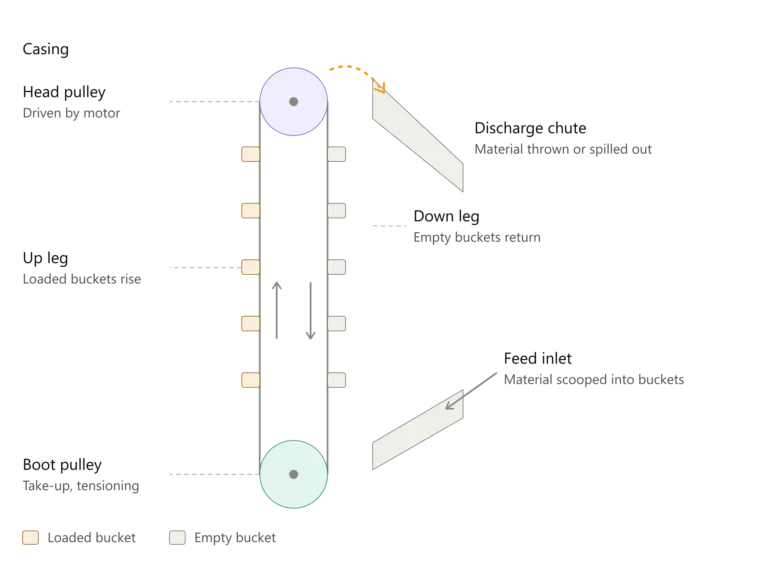
A bucket elevator is a machine that lifts bulk material vertically through the use of buckets attached to a belt or chain. Material enters at the bottom (the boot), rises in the buckets, and discharges at the top (the head).
The main parts are:
- Buckets that carry the material
- Belt or chain that drives the buckets
- Drives and Discharges with Header Section
- Boot section with take up and inlet
- Enclosed Casing that encloses the system and controls dust
Bucket elevators are used to move grain, cement, fertilizer, coal, sand, chemicals and other materials. Bucket elevators save floor space because the material is moved straight up.
What are the Main Types of Bucket Elevators?
| Type | How it discharges | Best suited for |
|---|---|---|
| Centrifugal discharge | Speed throws material out at the head | Free-flowing, fine to small-lump materials |
| Continuous discharge | Closely spaced buckets pour material over the bucket ahead | Heavier, sticky, or fragile materials at lower speed |
| Positive discharge | Buckets turn over the head so material falls out | Light, sticky, or dusty materials |
Centrifugal Discharge Bucket Elevator
This is the most common type. Buckets are spaced apart and run at higher speed, so material is flung out at the top. It works well for grain, sand, cement, and similar free-flowing material.
Continuous Discharge Bucket Elevator
Buckets sit close together and run slower. Material slides out gently, which suits abrasive,heavy, or breakable material.
Positive Discharge Bucket Elevator
Buckets are guided to invert fully. So sticky or lightweight material does not cling. It is a good choice when other types leave residue.
Belt Type vs Chain Type: Which One Should You Pick?
Choose a belt for light to medium duty, quieter operation and less maintenance. Select a chain for heavy, hot, abrasive or lumpy material where a belt may wear too quickly.
What industries are bucket elevators used in?
Cement: clinker, cement, fly ash
- Power plants: coal and ash handling
- Fertilizer: granules and powders
- Steel and mining: ore, sinter, and minerals
- Grain, food, and feed: rice, wheat, pulses, and pellets
- Chemicals: powders and granular products
How do you select the right bucket elevator?
Follow these steps in order. These are the same questions that any good manufacturer would ask you.
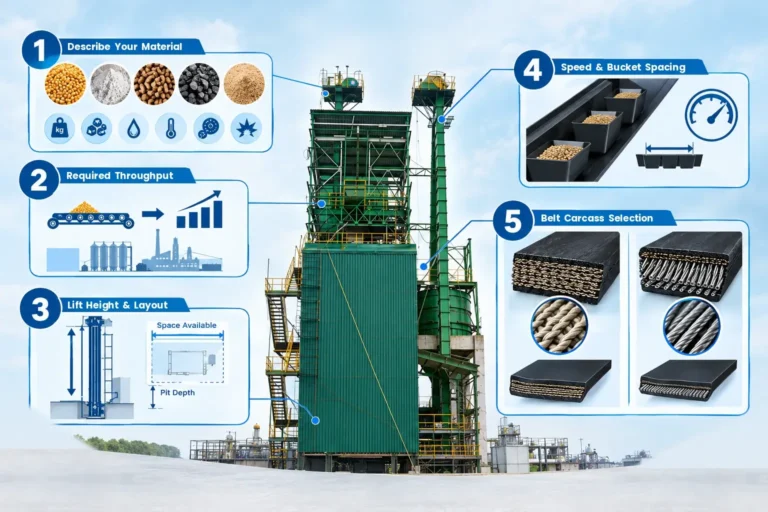
Step 1: Describe your material. Note bulk density, lump size, moisture,temperature,abrasiveness, and whether the dust can explode. This one step will help you narrow down what type of elevator you need.
Step 2: State your required throughput. Give your hourly requirement in tonnes, plus room for future growth. A capable manufacturer designs the elevator around your throughput, from a single feed line to continuous high-volume plant duty. It does not push a fixed catalogue size.
Step 3: Confirm lift height and layout. Share the height between inlet and discharge, and the space and pit depth available. Height affects belt tension, drive power, and structure.
Step 4: Match speed and bucket spacing. Wrong spacing or speed causes backlegging,where material falls back down the casing and wastes power. Ask your supplier to explain their choice.
Step 5: Pick the right belt carcass. The carcass is the strength layer inside the belt. Two common choices are:
- Fabric (EP or NN): flexible and works with smaller pulleys. It suits most standard lifts and capacities.
- Steel cord: much stronger, but stiffer. It needs a larger minimum bend radius,which means bigger head and boot pulleys and a larger machine.
How to decide: Use fabric for most applications. Consider steel cord only for very tall,high-tension duty where fabric cannot carry the load, and only if your layout can fit the larger pulleys. Always confirm the belt maker’s minimum pulley diameter first.
How do you choose a bucket elevator manufacturer in India?
A low quotation means little if the elevator fails in a year. Check these before you place an order:
- In-house manufacturing. Does the company fabricate, machine, and assemble in its own facility, or outsource the work?
- Proof of similar work. Ask for photos, references, or a site visit for a comparable installation.
- Certifications. Look for ISO 9001 quality certification at minimum.
- Drawings before you commit. They should share a general arrangement drawing and design basis for your approval.
- Custom engineering. Can they adjust height, material, temperature, and casing to your plant?
- Installation and support. Ask about commissioning, spares, and after-sales response.
- Honest lead time. Get a firm delivery schedule and ask about inspection before dispatch.
Why do buyers choose Methods India?
Methods India has been in bulk material handling since 1982, working from Hoskote,Bangalore. Fabrication, machining, assembly, surface preparation, and painting are handled under one roof, and the company is ISO certified. Buyers get one accountable team, from design through to supply, for bucket elevators built around their material and throughput.
What affects the cost of a bucket elevator?
Price depends on these factors:
- Lift height and required throughput
- Belt or chain type, and carcass choice
- Bucket size and material (mild steel, stainless, or abrasion-resistant)
- Casing thickness and dust or explosion protection
- Drive power and gearbox
- Installation, commissioning, and spares
Ask for the total cost of ownership, not only the purchase price. A cheaper elevator with frequent stoppages costs more over time.
Need A bucket Elevator For Your Plant?
Tell us your material, required throughput, and lift height. Then our engineers team will recommend the right design and share the quotation. Enquiry Now or call us to speak with an engineer.
FAQs
How do I know what capacity I need?
Work out the tonnes per hour your process must deliver, then add a margin for growth.Share this with the manufacturer along with your material details.They will size the elevator accordingly.
What is the difference between centrifugal and continuous discharge elevators?
Centrifugal elevators run faster and throw material out at the head. Continuous discharge elevators run slower with closely spaced buckets.That suits heavier or more delicate material.
Which is better, belt type or chain type?
Belt type suits light to medium duty with quieter running. Chain type suits heavy, hot, or abrasive material.
Can a bucket elevator be custom designed?
Yes.Height, bucket design, casing, speed, and drive can all be engineered to your material and plant layout.
How long does manufacturing and installation take?
It depends on size and design complexity. Ask your supplier for a written schedule covering drawings, fabrication, dispatch, and commissioning.
Which materials should not go in a bucket elevator?
Very sticky, large-lump, or highly abrasive material may need a different design or another conveying method. Discuss this with your manufacturer.
Need a bucket elevator for your plant?
Tell us your material, required throughput, and lift height. Then our engineers team will recommend the right design and share the quotation. Enquiry Now or call us to speak with an engineer.