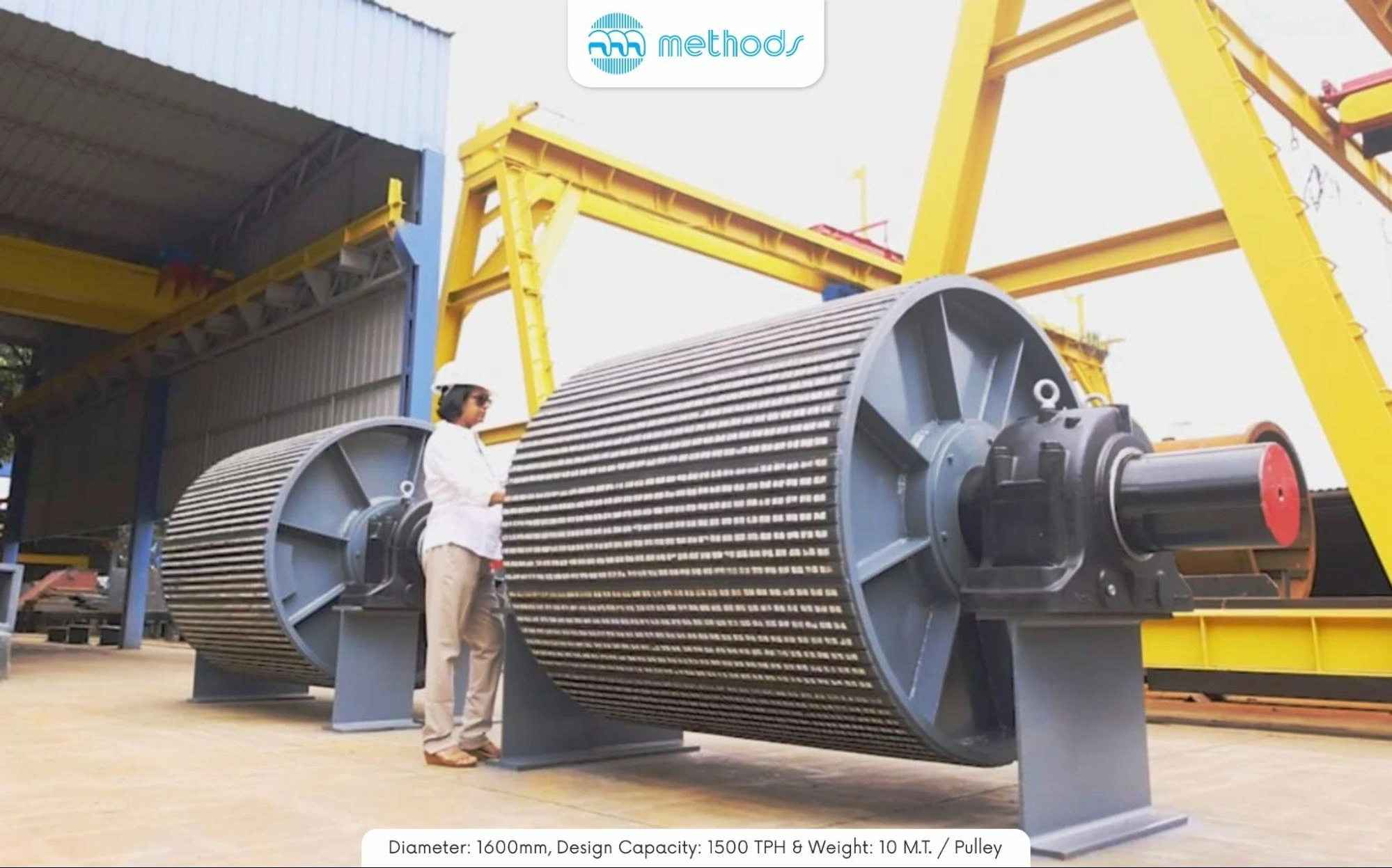
Types of Conveyor Pulleys and What Each One Does
To understand why conveyor pulleys need to be heavy-duty in mining applications, it helps to first understand the different types of conveyor pulleys and the role each one plays.
Drive Pulleys
The drive pulley is connected directly to the motor through a gearbox or coupling. This is the pulley that actually makes the belt move. When the motor turns, the drive pulley turns with it, and the friction between the pulley surface and the belt pulls the belt along.
Because the drive pulley is doing the actual work of moving the belt and everything on it, it experiences the highest torque and the highest stress of any pulley in the system. In mining conveyors, where belts can be carrying tons of ore or coal at any given moment, the drive pulley needs to be extremely strong. It also needs good grip, because if the drive pulley slips against the belt even slightly, that slippage generates heat, wears down the belt cover, and reduces how efficiently power gets transferred.
Tail Pulleys
The tail pulley sits at the loading end of the conveyor, where material is first dropped onto the belt. This is the pulley the belt wraps around before heading back underneath the conveyor structure on its return journey.
Tail pulleys take a lot of abuse in mining applications. This is where material first lands on the belt, often with some force and impact. Dust, fines, and small rocks tend to collect around the tail pulley area too. So tail pulleys need to be built tough, and they often need good sealing around the bearings to keep contaminants out.
Snub Pulleys
Snub pulleys are placed near the drive pulley, and their job is to increase the wrap angle of the belt around the drive pulley. In simple terms, they make the belt hug the drive pulley more closely, over a longer arc.
Why does this matter? Because the more contact area there is between the belt and the drive pulley, the more grip the drive pulley has. More grip means less slippage. Less slippage means more efficient power transfer and less wear on both the belt and the pulley surface. In heavy-load mining conveyors, snub pulleys play a quiet but important role in making sure the drive pulley can do its job without slipping.
Bend Pulleys
Bend pulleys are used wherever the conveyor’s path needs to change direction. Maybe the conveyor needs to go around an obstacle, or maybe it needs to redirect the belt on its return path underneath the structure. Bend pulleys make these direction changes possible without putting excessive strain on the belt.
Because bend pulleys often operate at different angles and under varying tension conditions depending on the conveyor’s layout, they need to be precisely aligned. A misaligned bend pulley can cause the belt to drift to one side, which over time leads to edge wear and tracking problems.
Take-Up Pulleys
Take-up pulleys are part of the tensioning system of the conveyor. Conveyor belts naturally stretch over time due to the loads they carry and the heat generated during operation. If the belt becomes too loose, it will slip on the drive pulley and may sag between idlers, causing material spillage.
The take-up pulley moves along a track, either through a screw mechanism, a gravity-based system, or a hydraulic system, to maintain the correct tension on the belt at all times. In long mining conveyors, where belts can stretch significantly over their lifetime, take-up pulleys need to handle a wide range of movement while still maintaining smooth rotation and proper alignment.
Each of these conveyor pulleys, drive, tail, snub, bend, and take-up, has to be engineered for the specific load, speed, belt width, and material being handled. In a mining environment, where loads are heavy and conditions are harsh, every one of these pulleys needs to be built to a higher standard than what you would use in a light-duty application.
Why Mining and Bulk Material Handling Demand Heavy-Duty Conveyor Pulleys?
Mining is, without question, one of the harshest environments for any mechanical equipment. If you have ever visited a mine site, you know exactly what we mean. The air is thick with dust.The ground is uneven and often wet or muddy. Heavy machinery is constantly moving around.Temperatures can swing from extreme heat to cold, depending on the region and season. And the materials being handled, whether it is coal, iron ore, limestone, or other minerals, are often abrasive, heavy, and sometimes chemically aggressive.
Now imagine a conveyor pulley operating in the middle of all this, day after day, often running 24 hours a day with very little downtime for inspection. A regular, light-duty pulley simply cannot survive these conditions for long.Here’s what typically happens when plants use pulleys that aren’t built for mining-grade duty.The shell of the pulley, which is the outer surface that the belt rides on, starts to dent or deform under the constant heavy load. Once the shell loses its perfectly round shape, the belt no longer sits evenly on it. This causes uneven wear on the belt and creates vibration throughout the system.
The shaft, which carries the entire weight and load of the pulley assembly, can develop fatigue cracks over time if it wasn’t designed with enough strength margin for the actual operating loads. A cracked or bent shaft is a serious failure. It often means the entire pulley assembly needs to be replaced, and depending on the conveyor’s design, this can mean significant downtime to remove and refit.
The bearings, which allow the pulley to rotate smoothly on the shaft, are extremely vulnerable to dust and moisture if they aren’t properly sealed. In a mining environment, fine particles get everywhere. If dust works its way into a bearing, it acts like sandpaper, grinding away at the internal components every time the pulley rotates. This leads to bearings failing far earlier than they should, sometimes within months instead of years.
And the surface of the pulley itself, if it doesn’t have proper lagging or protective treatment, can lose grip on the belt, especially when conditions are wet or when fine material gets between the belt and the pulley surface. Once grip is lost, slippage begins, and slippage generates heat.That heat can damage the belt cover, and in extreme cases, can even become a fire risk if the belt material is not heat-resistant.
This is exactly why heavy-duty conveyor pulleys exist as a category of their own. They are not just bigger versions of regular pulleys. They are engineered from the ground up, using thicker materials, better manufacturing processes, and protective features, to handle the punishment of mining and bulk material handling operations day after day, year after year.
A Detailed Look at the Features That Make Conveyor Pulleys Truly Heavy-Duty
When we talk about heavy-duty conveyor pulleys at Methods India, we are not just talking about a marketing term. We are talking about a set of specific engineering features that together determine how well a pulley will perform under demanding conditions. Let’s go through each of these in detail.
Strong Shell Construction
The shell is the cylindrical outer body of the pulley, the part that the belt actually wraps around and rides on. In a heavy-duty conveyor pulley, this shell is made from thick-walled steel pipe or rolled steel plate, welded carefully to maintain a perfectly round shape.Why does shell thickness matter so much? Because the shell is constantly under bending stress as the belt presses down on it with the weight of the material being carried. If the shell is too thin, it can flex slightly under load. Over thousands and millions of cycles, this flexing leads to metal fatigue, and eventually the shell can crack or deform.
A thicker shell resists this flexing. It stays rigid under load, which means the belt always sits on a true, round surface. This translates directly into smoother belt tracking, less vibration, and a longer life for both the pulley and the belt itself.At Methods India, we calculate shell thickness based on the actual operating loads, belt width, and pulley diameter for each application, rather than using a generic thickness for every pulley we make. This means the shell is strong enough for the job, without adding unnecessary weight or cost.
Precision-Machined Shafts
The shaft is the central axle that the entire pulley assembly rotates around. It carries the full weight of the pulley, the tension from the belt, and the load being transmitted. In
heavy-duty mining conveyors, shafts can be subjected to enormous forces, especially on drive pulleys where torque from the motor is being transferred.A precision-machined shaft is manufactured to very tight tolerances. This means the shaft is perfectly straight, with no bends or irregularities, and the areas where bearings and other components mount onto the shaft are machined to exact dimensions.
Why does this precision matter? Because even a tiny amount of misalignment or irregularity in the shaft can cause the entire pulley to wobble slightly as it rotates. This wobble, even if it’s barely visible to the eye, creates vibration. And vibration is one of the biggest enemies of conveyor systems. It causes accelerated wear on bearings, it loosens bolted connections over time, and it can even cause fatigue cracking in the shaft itself.So, a precision-machined shaft isn’t just about quality for quality’s sake. It directly affects how smoothly the pulley runs, how long the bearings last, and how much vibration gets transmitted to the rest of the conveyor structure.
Quality Bearings and Proper Sealing
Bearings are what allow the pulley to rotate freely around the shaft with minimal friction. In a heavy-duty conveyor pulley, the choice of bearing and how well it is sealed against the environment makes an enormous difference to the pulley’s working life.In mining applications, bearings face two main enemies: contamination and excessive load.Contamination comes from dust, dirt, and moisture finding their way into the bearing housing.Excessive load comes from the sheer weight and forces the pulley is dealing with on a continuous basis.
To deal with contamination, heavy-duty conveyor pulleys use sealed bearing housings with multiple layers of protection, often including lip seals, V-ring seals, and sometimes even labyrinth seals that create a physical barrier against dust and water ingress. Some designs also include grease nipples that allow fresh grease to be pumped in periodically, which helps push out any contamination that does manage to get in.
To deal with load, the bearing size and type are selected based on the actual forces the pulley will experience, not just a standard size that fits the shaft diameter. This means a careful calculation of radial loads, axial loads, and the expected operating speed.Also, proper lubrication matters just as much as the bearing itself. A high-quality bearing with the wrong grease, or with grease that isn’t replenished on schedule, will still fail prematurely. So heavy-duty conveyor pulleys are designed with maintenance in mind too, with accessible grease points and clear lubrication intervals.
Lagging for Better Grip and Belt Protection
Lagging refers to a layer of material, usually rubber or ceramic, that is bonded onto the shell of the pulley. Lagging serves a few important purposes, and understanding them helps explain why it’s such a critical feature for heavy-duty conveyor pulleys.
First, lagging increases the coefficient of friction between the pulley surface and the belt. This is especially important for drive pulleys. A plain steel pulley surface, especially when wet or dusty,can become quite slippery. If the belt slips on the drive pulley even slightly, the conveyor loses efficiency, and that slippage generates heat that can damage the belt.
Second, lagging acts as a cushion between the steel shell and the belt. This reduces wear on the belt cover, particularly at points where the belt makes contact with the pulley under tension.
Third, certain types of lagging, particularly grooved rubber lagging, help shed water and material fines from the pulley surface. In wet mining conditions, this is incredibly important. Without grooving, water and fine particles can build up between the belt and the pulley, creating a slippery film that reduces grip.
For especially abrasive applications, ceramic lagging is often used instead of rubber. Ceramic tiles are embedded into the rubber lagging and provide extremely high friction along with excellent resistance to wear from abrasive materials like iron ore or crushed rock. Ceramic lagging costs more upfront, but in highly abrasive mining applications, it lasts significantly longer than rubber alone, which makes it cost-effective over the life of the conveyor.
The choice between plain steel, rubber lagging, or ceramic lagging depends entirely on the application, the material being handled, and the environmental conditions. This is something we evaluate carefully for every conveyor pulley we manufacture.
Corrosion-Resistant Coating and Protection
Mining sites are often humid, and many minerals being processed can be chemically reactive,especially when combined with moisture. Coal, for instance, can produce acidic conditions when wet. Certain ores can also create corrosive environments around the conveyor structure.
A conveyor pulley’s shell and shaft are made of steel, and steel corrodes when exposed to moisture and chemicals over time. Corrosion doesn’t just affect the appearance of the pulley. It actually eats away at the metal, reducing the wall thickness of the shell and weakening the structure over time. Corrosion around bearing housings can also damage seals and allow contamination to enter.
Heavy-duty conveyor pulleys are protected against corrosion through a combination of surface preparation, primer coatings, and final protective paint systems designed for harsh outdoor and industrial environments. In some cases, depending on the severity of the environment,additional protective measures like galvanizing or specialized epoxy coatings may be used.
This protection extends the working life of the pulley significantly. A pulley that might start showing corrosion-related issues within a couple of years in an unprotected state can last well over a decade with proper corrosion protection, even in a humid mining environment.
Dynamic Balancing
Every conveyor pulley, no matter how well it’s manufactured, will have some tiny variations in weight distribution around its circumference. This is simply a result of manufacturing tolerances,welding, and the assembly of different components onto the shaft.If these weight variations aren’t addressed, the pulley will be slightly out of balance. At low speeds, this imbalance might not be noticeable. But as the pulley speed increases, even a small imbalance creates a centrifugal force that grows with the square of the speed. This means a pulley that seems fine at low speed can create significant vibration at higher operating speeds.
Dynamic balancing is a process where the pulley assembly is spun on a specialized machine that detects exactly where the imbalance is and by how much. Small weights are then added or material is removed at precise locations to bring the pulley into balance.For high-speed mining conveyors, dynamic balancing isn’t optional. It’s essential. An out-of-balance pulley running at high speed will transmit vibration throughout the entire conveyor structure, accelerating wear on bearings, loosening structural bolts, and creating noise. Over time, this vibration can even contribute to fatigue cracking in the conveyor frame itself.
At Methods India, every heavy-duty conveyor pulley we manufacture for high-speed applications goes through dynamic balancing as a standard part of our quality process, not as an optional extra.
How Heavy-Duty Conveyor Pulleys Directly Improve Productivity
All of these features we’ve discussed aren’t just technical details for the sake of engineering perfection. They translate into real, measurable benefits for a mining or bulk material handling operation.
When conveyor pulleys are built to handle heavy, continuous loads without deforming or failing,the most immediate benefit is a dramatic reduction in unplanned downtime. Unplanned downtime in mining is incredibly expensive. It’s not just the cost of repairing or replacing the failed pulley. It’s the cost of the entire conveyor being offline, the material that isn’t being moved,the trucks or downstream equipment that are now sitting idle, and sometimes the cost of bringing in emergency repair crews at short notice.
When pulleys grip the belt properly, through good lagging and proper tensioning via take-up pulleys, belt slippage is minimized. This matters for two reasons. First, slippage wastes energy.The motor is working, but the belt isn’t moving at the rate it should be, which means the conveyor isn’t transporting material as efficiently as it could be. Second, slippage generates heat at the contact point between the belt and pulley. Repeated heat exposure damages the rubber cover of the belt, leading to premature belt replacement, which is itself a major cost in any conveyor system.
When pulleys are precisely machined and dynamically balanced, vibration throughout the conveyor structure is reduced. Lower vibration means less wear on every other component in the system, not just the pulley itself. Bearings throughout the conveyor last longer. Structural bolts stay tight longer. Idler rollers experience less stress. In a sense, a well-engineered pulley
protects the health of the entire conveyor system, not just itself.
And when pulleys are protected against corrosion and contamination, their service life extends significantly. This means fewer replacement cycles, less spending on spare parts, and less time spent by maintenance teams swapping out worn components.When you add all of this up, the impact of heavy-duty conveyor pulleys on a mining operation’s overall productivity becomes very clear. Every hour the conveyor runs without interruption is an hour of material moving toward processing or shipping. Every percentage point of efficiency gained through reduced slippage translates into lower energy bills across an operation that might run conveyors for thousands of hours every year. And every extension in the working life of major components reduces the long-term cost of running the conveyor system.
How Methods India Engineers Conveyor Pulleys for Mining and Bulk Material Handling
At Methods India, we don’t treat conveyor pulleys as a generic, off-the-shelf product. Every pulley we manufacture is engineered with the specific application in mind, and we manufacture our pulleys in-house, which gives us complete control over quality from start to finish.Our process begins with understanding the application. We look at the belt width, the belt speed, the type of material being conveyed, the conveyor’s layout, and the environmental conditions at the site. This information determines the shell thickness, shaft diameter, bearing selection, and lagging type for the pulley.
We use premium-grade steel for both the shell and the shaft. This steel is selected specifically for its ability to withstand heavy loads, repeated stress cycles, and outdoor exposure without bending, cracking, or excessive corrosion. Our fabrication process includes careful welding to maintain the roundness of the shell, followed by precision machining of the shaft and mounting surfaces.
Every pulley assembly goes through dynamic balancing before it leaves our facility, particularly for applications involving higher belt speeds. This ensures that when the pulley is installed and the conveyor starts running, there are no surprises related to vibration.
For lagging, we offer options based on the application’s needs. For general bulk material handling where conditions are relatively dry, rubber lagging provides excellent grip and belt protection at a reasonable cost. For mining applications involving wet, muddy, or highly abrasive materials, we recommend ceramic lagging, which provides superior grip and dramatically extends the life of the lagging itself, even when handling sharp, abrasive ores.
Our bearing housings are designed with sealing systems appropriate for the operating environment, and we ensure that lubrication points are accessible for ongoing maintenance,because we know that even the best bearing needs proper care over its lifetime to perform as intended.
Finally, every pulley goes through our quality assurance checks before it ships. We check dimensional accuracy, surface finish, weld quality, and balance. This way, when a conveyor pulley from Methods India arrives at your site, it’s ready to be installed and run reliably from day one.
Choosing the Right Conveyor Pulleys for Your Plant
This is probably the most important section of this entire blog, because no matter how well-engineered a conveyor pulley is in general, it has to be right for your specific plant, your specific conveyor, and your specific operating conditions. A pulley that works perfectly in one mine might not be the right choice for another mine just a few kilometers away, simply because
the materials, layout, or conditions are different. So let’s go through, in detail, what you should actually be thinking about when selecting conveyor pulleys.
Start With the Material Being Handled
The very first thing to consider is what material your conveyor is actually moving. This sounds obvious, but it has a huge impact on pulley selection, and it’s often underestimated.
If you’re handling highly abrasive materials like iron ore, crushed stone, or certain types of coal with high ash content, the pulley surface is going to face constant abrasive wear, especially at the tail pulley where material first lands, and at any point where fines can get trapped between the belt and the pulley. For these applications, ceramic lagging is usually the right choice, even though it costs more initially. The extended life and reduced slippage more than make up for the higher upfront cost over time.
If you’re handling materials that are chemically aggressive, for example certain ores that produce acidic runoff when wet, or materials that contain corrosive salts, the corrosion protection on the pulley shell and shaft becomes even more critical. In these cases, we often recommend additional protective coatings or even specialized materials for components that will be in direct contact with the corrosive environment.
If your material tends to be sticky or prone to building up on surfaces, like certain types of wet clay or some processed minerals, you need to think about pulley designs that resist material buildup, because buildup on a pulley surface effectively changes its diameter and shape, which causes belt mistracking and uneven wear over time. Self-cleaning pulley designs or specific lagging patterns can help in these situations.
Consider the Belt Speed and Tension Carefully
The speed at which your belt runs, and the tension it operates under, directly affects almost every design decision for the pulley.
Higher belt speeds mean the pulleys are rotating faster, which means dynamic balancing becomes absolutely critical. As we discussed earlier, even small imbalances become significant problems at higher speeds. If your conveyor operates at high speed, don’t compromise on balancing, no matter how tempting it might be to save a little on cost.
Higher belt tension, which is common in long-distance conveyors or conveyors handling very heavy loads, means the pulley shaft and bearings are dealing with much higher forces. This is where shaft diameter and bearing selection become critical. An undersized shaft on a high-tension application is a recipe for fatigue failure down the line, sometimes much sooner than expected.
It’s also worth thinking about how belt tension might change over the life of the conveyor. As belts age and stretch, and as take-up systems adjust to compensate, the loads on certain pulleys, particularly the take-up pulley itself, can shift. A good pulley design accounts for this range of operating conditions, not just the conditions on day one.
Think About the Operating Environment in Detail
We touched on this earlier, but it deserves a closer look when you’re actually making a selection decision for your plant.
Is your conveyor located outdoors, exposed to rain, sun, and temperature swings? Or is it located underground or in an enclosed area where conditions might be more stable but humidity could be consistently high? Each of these environments calls for different levels of protection.
Outdoor conveyors in regions with heavy monsoon seasons, which is common across much of India, need pulleys with robust sealing against water ingress, and corrosion protection that can handle prolonged exposure to moisture. If your site experiences significant temperature variation between seasons, the materials used in seals and lagging need to handle that range without becoming brittle in the cold or too soft in the heat.
Underground mining conveyors often deal with consistently high humidity and limited ventilation,which can create their own corrosion challenges, even if the pulleys aren’t directly exposed to rain. Dust levels underground can also be extremely high in certain operations, which puts extra demand on bearing seals.
If your site has particularly dusty conditions, whether from the material being handled or from the surrounding terrain, this is where the quality of bearing seals becomes one of the most important factors in pulley selection. A pulley with excellent shell strength but poor bearing protection will still fail prematurely in a dusty environment, because the bearings will be the first thing to go.
Factor In the Conveyor’s Layout and the Pulley’s Specific Role
As we discussed in the section on types of conveyor pulleys, different pulleys in the same conveyor system can have very different requirements based on their role.
The drive pulley, for example, needs to prioritize grip and torque transmission, which usually means it will have lagging and will need careful attention to shaft strength because it’s directly coupled to the drive system. The tail pulley needs to prioritize durability against impact loading from material being loaded onto the belt, and good sealing because it’s often in the dustiest part of the conveyor. Bend pulleys need to prioritize alignment precision, because their job is purely directional and any misalignment causes belt tracking problems. Take-up pulleys need to be designed for the full range of movement and tension variation they’ll experience over the belt’s life.
So when you’re selecting conveyor pulleys for your plant, it’s not enough to think about “the pulleys” as one category. Each position in the conveyor has its own demands, and the right approach is to specify each pulley according to its actual role, rather than using identical specifications across the board for simplicity.
Don’t Underestimate Future Maintenance Access
One factor that’s often overlooked during the initial selection process is how easy or difficult it will be to maintain and eventually replace the pulley once it’s installed.
Pulleys with accessible grease points, bearings that can be inspected without major disassembly, and designs that allow for easier removal and replacement save enormous amounts of time and labor over the life of the conveyor. This is especially important for pulleys located in hard-to-reach positions, such as those underneath long conveyor structures or in confined spaces.
When you’re working with a manufacturer on conveyor pulley selection, it’s worth discussing not just how the pulley will perform on day one, but how it will be maintained over the years, and how straightforward it will be to replace if and when that day eventually comes, because even the best heavy-duty pulley will eventually need replacement after years of service, and planning for that from the start saves a lot of headaches later.
Work With a Manufacturer Who Understands Your Application
Perhaps the most important piece of advice we can give is this: choosing the right conveyor pulleys isn’t something that should be done from a catalog alone. It requires a conversation about your specific application, your material, your environment, and your operational goals.
At Methods India, this is exactly how we approach every conveyor pulley order. We ask about the material being handled, the belt specifications, the environmental conditions at your site,and how the conveyor fits into your broader operation. Based on this information, we recommend shell thickness, shaft design, bearing types, sealing arrangements, and lagging options that are matched to your actual needs, not generic defaults.
This approach takes a bit more time upfront compared to simply picking a standard part off a shelf. But it pays off enormously over the operating life of the conveyor, in the form of fewer breakdowns, longer component life, and a conveyor system that performs the way it’s supposed to, year after year.
Conclusion
Conveyor pulleys might be small compared to the rest of a conveyor system, but their importance is enormous. They are the components that make the belt move, guide it, tension it,and keep the entire system running smoothly. In mining and bulk material handling, where conditions are harsh and downtime is extremely costly, the difference between regular pulleys and properly engineered heavy-duty conveyor pulleys can mean the difference between a conveyor that runs reliably for years and one that causes constant headaches and breakdowns.
We’ve covered a lot of ground in this blog, from the different types of conveyor pulleys and the specific job each one does, to the detailed engineering features that make a pulley truly heavy-duty, to how all of this translates into real productivity gains, and finally, how to think carefully about choosing the right conveyor pulleys for your specific plant.
Methods India brings more than 40 years of manufacturing experience to every conveyor pulley we build. With in-house manufacturing, careful application-specific engineering, and a focus on quality at every step, we help mining and bulk material handling plants across India reduce downtime, extend equipment life, and keep their conveyors running the way they’re meant to.
If you’re evaluating conveyor pulleys for your mining or bulk material handling operation, and you want a manufacturer who will take the time to understand your application before recommending a solution, Methods India is ready to help.