

The Evolution of Bulk Material Handling Equipment in India: Trends & Technologies
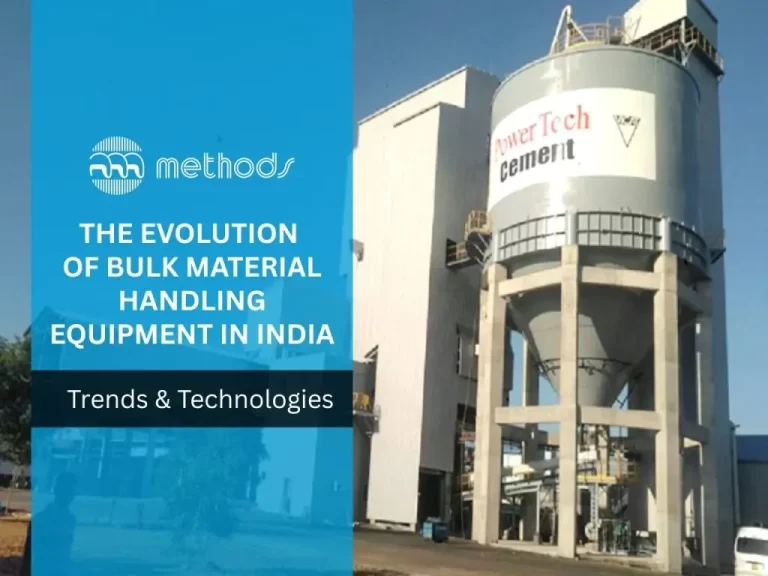
The need for effective, secure, and sustainable bulk material handling equipment has increased dramatically as India’s industrial landscape develops, encompassing mining, power, infrastructure, and agriculture.Bulk handling systems are now crucial to India’s production infrastructure, whether they are used for handling biomass in a sugar mill, transporting limestone in a cement plant, or moving coal in a thermal power plant. India’s bulk material handling equipment has changed dramatically over the years. Also,it has developed into a complex field propelled by automation, engineering innovation, and sustainable design after initially restricted to simple mechanical setups. Also,we examine current trends and technologies, trace the development of bulk material handling equipment, and show how industry leaders like Methods India are influencing the future of the sector in this blog.
A Glimpse into the Past: Early Bulk Material Handling in India:
During the early stages of industrial development, India based material handling on basic, manually operated, or semi-mechanized systems. Although manufacturers widely used hoppers, belt conveyors, and chain conveyors, these systems lacked adaptability for large-scale applications, safety regulations, and efficiency. So,there was little customization, and the majority of solutions imported or reverse-engineered. So,the first wave of indigenous bulk material handling systems was introduced in the 1980s and 1990s when industries expanded and Indian engineering companies started to develop and produce equipment suited to local conditions.
Modern Trends Shaping Bulk Material Handling Equipment in India:
Today, the sector has become a hotbed of innovation, with smart technologies, environmental compliance, and sector-specific customization at its core. Here’s what’s driving the evolution:
1. Automation and Smart Control:
Also,Modern bulk material handling equipment in India is increasingly integrated with PLCs, SCADA, and IoT sensors. So,these technologies allow real-time monitoring, predictive maintenance, and process optimization, minimizing downtime and maximizing throughput.
2. Energy-Efficient Designs:
Energy consumption has become a key concern. From regenerative drives to low-friction conveyor materials, manufacturers are innovating to lower power usage while maintaining performance.
3. Dust and Pollution Control Integration:
With stricter environmental norms, systems now include dust extraction, water spray units, and closed conveyors, ensuring cleaner operations and safer work environments.
4. Modular and Scalable Systems:
Also,industries want solutions that grow with them. Modular designs in hoppers, feeders, and stackers are now preferred for faster installation, easy expansion, and reduced maintenance.
5. Industry-Specific Customization:
Whether it’s anti-corrosion coatings for port equipment or abrasion-resistant liners for mining conveyors, customization has become a key differentiator in today’s market.
Also Read: Bulk Material Handling Systems in India: Trends, Innovations & Future
Types of Bulk Material Handling Equipment in Use Today:
Some of the most widely used bulk material handling equipment in India includes:
- Belt Conveyors (flat, trough, and pipe types).
- Screw Conveyors for powders and granules.
- Drag Chain Conveyors for heavy-duty materials.
- Stacker-Reclaimers in storage yards.
- Pneumatic Conveying Systems for light and sensitive materials.
- Hoppers, Silos, and Feeders for controlled storage and flow.
- Also,Dust Suppression Systems for compliance and cleanliness.
So,these systems are now designed to handle a wide variety of materials—abrasive, sticky, free-flowing, or moisture-sensitive—based on the industry and application.
The Role of Methods India in Driving Innovation:
Also,at the forefront of this evolution is Methods India Pvt. Ltd., a pioneer in delivering turnkey bulk material handling solutions across India and 36+ countries worldwide. With over 40 years of experience, they offer fully in-house design, engineering, fabrication, and commissioning of customized systems.
What Sets Methods India Apart?
- Proven success in sectors like cement, sugar, mining, power, and ports.
- Complete in-house manufacturing facilities with precision quality control.
- Also,Environmentally responsible designs and ISO-certified processes.
- Innovation in bulk material handling equipment, such as cross-country conveyors, biomass handling systems, and dense-phase conveying.
Whether it’s a sugar plant in Tamil Nadu or a fertilizer terminal in Sri Lanka, Methods India delivers solutions that are robust, efficient, and tailored to exact industrial needs.
The Future of Bulk Material Handling Equipment in India:
Looking ahead, the future is geared toward intelligent, connected, and green systems. Key trends to watch include:
- Also,AI and Machine Learning for autonomous operations and failure prediction. Digital Twins for system simulation and layout optimization.
- Hybrid Material Handling—combining pneumatic and mechanical systems for flexibility.
- Also,use of Composite and Lightweight Materials for corrosion resistance and energy savings.
- Sustainability-First Designs to align with net-zero targets and circular economy goals.
With rapid urbanization, infrastructure development, and government initiatives like Make in India and Smart Manufacturing, the sector is poised for exponential growth.
Conclusion:
Also,from manual labour to intelligent automation, from imported machinery to indigenous innovation, the development of bulk material handling equipment in India is a reflection of the larger narrative of industrial progress. So,selecting the appropriate equipment and partner is more crucial than ever as industries deal with new speed, scale, and sustainability challenges. Also,Methods India remains at the forefront of bulk material handling, establishing new standards for a rapidly changing industrial world with its extensive experience, cutting-edge technologies, and customer-focused philosophy.