7 Advantages of Pipe Conveyors for Bulk Material Handling
Moving bulk materials such as coal, limestone, clinker, fly ash, fertilizer, and ore is a major cost and compliance challenge for mining, cement, power, and process plants. Open belt conveyors and trucks are the usual solutions, but they often bring spillage, dust, and routing limits that slow down operations and increase expenses. A pipe conveyor addresses many of these problems in a single system, and the seven advantages below explain why more plants are choosing it for bulk material handling.
What Is a Pipe Conveyor?
A pipe conveyor is a closed-belt system in which the belt is rolled into a circular tube around the material after loading. Idler rolls arranged in a hexagonal pattern hold the belt in this shape along the carrying run, and the belt opens flat again at the discharge end. The material stays fully enclosed from the loading point to the discharge point, and in many designs the return belt also stays closed, so it remains much cleaner than on a conventional conveyor.
1. Dust-Free, Environment-Friendly Transport
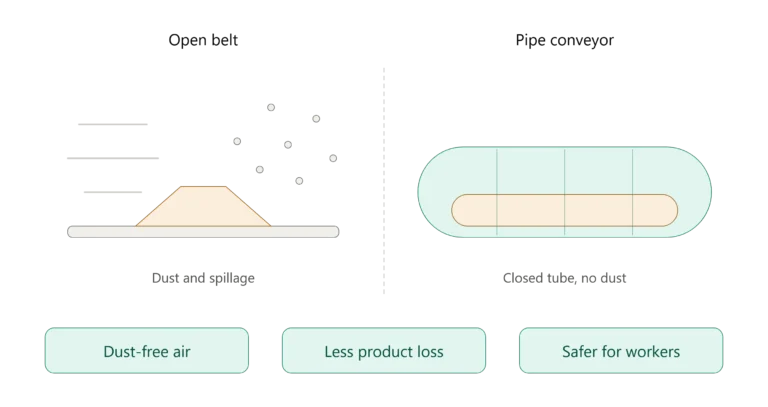
Since the material is moving inside a closed tube.So there is no dust in the air.Also the wind cannot blow light pieces off the belt. This is a great advantage to plants that have to meetenvironmental and pollution control regulations. It improves the quality of the air around the plant. Also keeps the area around the plant clean and protects the workers from exposure to dust. It also reduces product loss, which is important in fine powdery materials such as fly ash and cement raw mix. This benefit alone can be the decisive factor in selecting a pipe conveyor for industries facing mounting regulatory pressure.
2. Minimal Spillage and a Cleaner Return Belt
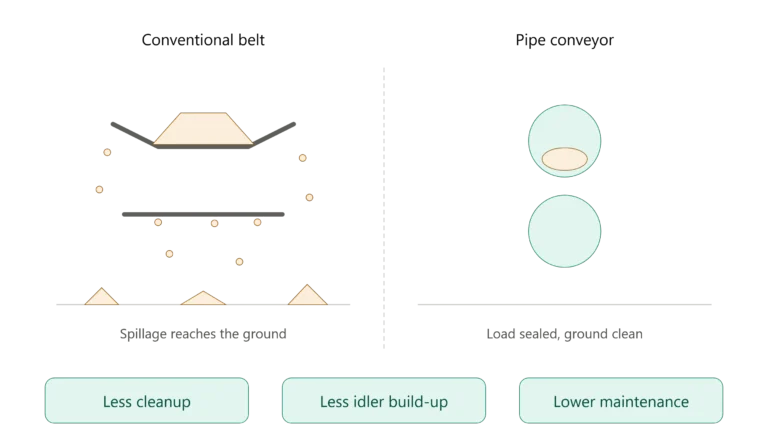
On a conventional troughed belt, material often falls off along the carrying side or sticks to the return belt and drops along the route. A pipe conveyor keeps the load sealed in the tube,so far less material reaches the ground beneath the structure. This means less cleanup effort and labour, a lower risk of build-up on idlers and supporting steelwork, and better protection for nearby land, drains, and equipment. Over the years, the savings in housekeeping and maintenance can be significant.
3. Ability to Negotiate Horizontal and Vertical Curves
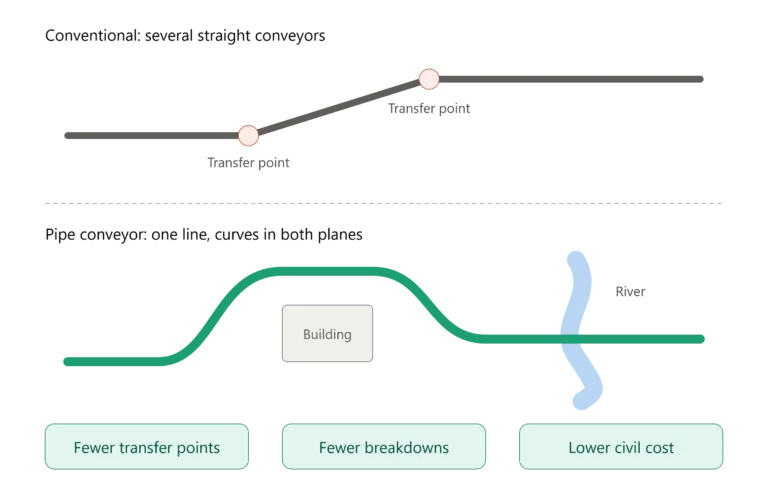
One of the strongest technical advantages of a pipe conveyor is that it can follow curves in both the horizontal and vertical planes. A single continuous system can therefore often replace several straight conveyors and the transfer points between them. This is particularly valuable where the terrain is uneven, the route is congested, or the conveyor has to pass around buildings, roads, rivers, or existing plant structures. Since every transfer point is a possible source of dust, blockage, and breakdown, having fewer of them improves reliability and lowers the cost of civil work and equipment.
4. Higher Incline Capability
The enclosed material is held securely by the closed belt.Pipe conveyors can typically handle steeper inclines than open troughed belts. A steeper incline allows a shorter route and a lighter structure to reach a given height.This reduces both material and installation costs. The achievable angle depends on the material characteristics and the specific design.So it should always be confirmed through an engineering study for your application.
5. Suitable for Long-Distance and Cross-Country Conveying
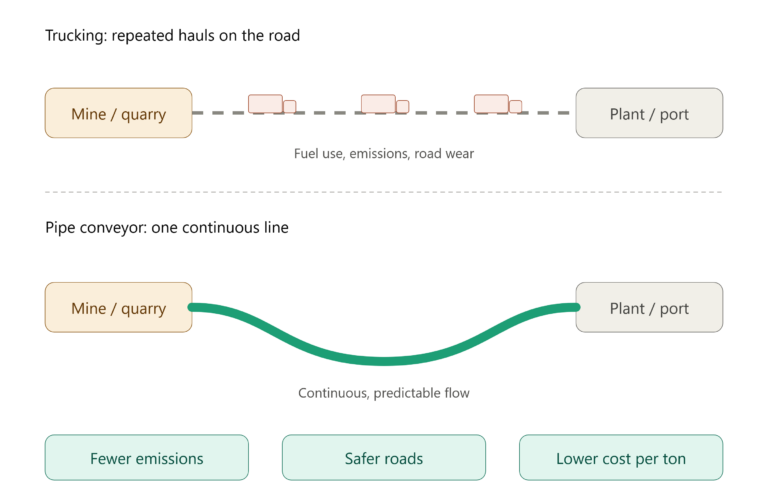
Pipe conveyors are well suited to long routes.Especially where the path needs to bend with the terrain.They are often used in cross-country applications such as moving material from a mine or quarry to a processing plant or port without the need for repeated rehandling or heavy truck traffic. Trucking has higher fuel consumption, more vehicle emissions, more road wear and safety risks, and not the continuous, predictable flow of material that a conveyor provides. This often results in a lower cost per ton moved over the life of a project.
6. Protection from Weather and Contamination
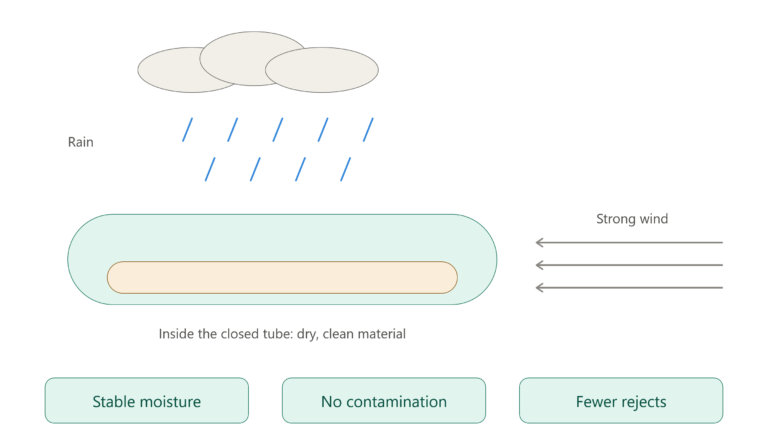
The closed tube protects the cargo from rain, wind and outside contamination.It helps to keep the moisture content of the material stable during transport.This is of particular benefit for hygroscopic products such as fertilizers and cement, for sensitive or hazardous materials.Also suitable for projects in areas of heavy rainfall or strong winds. The quality of the material is consistent from loading point to delivery point. This leads to fewer losses and rejects.
7. Lower Operating Costs and a Smaller Environmental Footprint
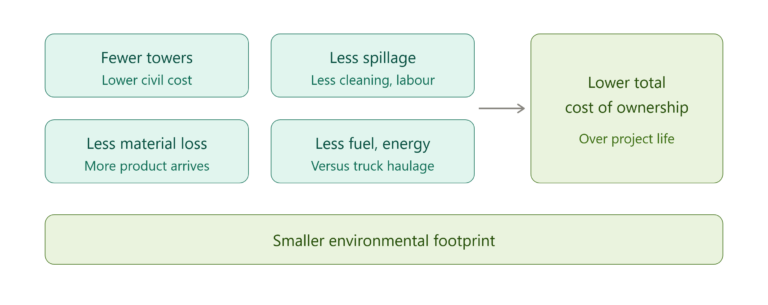
When the earlier advantages are combined, they lead to meaningful long-term savings.Fewer transfer towers reduce structural and civil costs, less spillage reduces cleaning and manpower, and reduced material loss means more product reaches its destination.Compared with truck haulage over similar distances, conveying also uses less energy and fuel. The initial investment varies by project, but many plants find that the total cost of ownership compares well once dust control, spillage cleanup, and routing flexibility are taken into account.
Where Are Pipe Conveyors Used?
Pipe conveyors are used across many industries. Mines and quarries use them to move ore, coal, and limestone, while cement plants rely on them for raw materials, clinker, gypsum, and fly ash. Power plants use them for coal, ash, and biomass, and fertilizer and chemical plants use them for granular and powdered products. Ports and terminals also adopt them for cleaner loading and unloading of bulk cargo.
Things to Consider Before Choosing a Pipe Conveyor
A pipe conveyor is not the right answer for every application, and good design depends on several factors. The material’s lump size, density, moisture, abrasiveness, and flowability all influence the choice, as does the required capacity, since the pipe diameter must suit both the tonnage and the largest lump. The route layout, including curve radii, inclines, and total distance, affects the drive and belt selection, and maintenance access such as idler design, belt splicing, and inspection provisions should be planned from the start. Working with an experienced engineering partner early in the project helps avoid costly redesign later.
Why Work with Methods India?
Methods India is a bulk material handling company based in Bangalore. With offices across India, Sri Lanka, and Australia and product installations in 36 countries. The company provides turnkey bulk material handling systems, structural design and fabrication.Also provide industrial pollution control, along with specialist services such as pipe conveying, cross-country conveying, and complex material handling consultation for mining, cement, power, and process industries. If you are planning a new conveying system or looking to upgrade an existing one. Then Methods India team can help you assess whether a pipe conveyor suits your material, route, and budget.
Conclusion
Pipe conveyors offer a clean, flexible, and efficient way to transport bulk materials. Their closed design, ability to follow curves and inclines, suitability for long distances.Also lower operating costs make them a strong alternative to troughed belt conveyors and trucks. Most preferable where environmental compliance and tight routing are priorities.